
 135-6073-0094
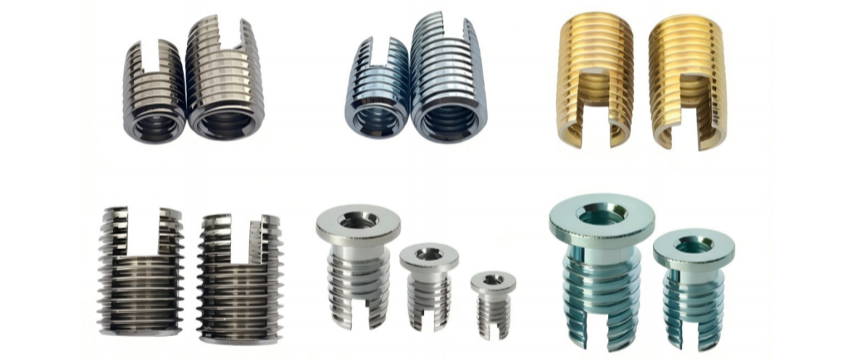
The common root cause of these problems is often that the substrate material is "soft" and the threads are "weak." The key to solving them lies in a small component — the thread insert (wire insert / threaded bushing / Thread Insert).
Drawing on Yongjing Precision's engineering experience in fastening connections, this article systematically reviews the applicable working conditions, core value, mainstream types, and selection essentials of thread inserts, for the reference of colleagues in design, process, and procurement.
1. What Is a Thread Insert? What Working Conditions Does It Address?
A thread insert is a type of internal/external threaded bushing pre-embedded in the substrate's threaded hole. Essentially, it rebuilds a stronger, more wear-resistant, and repeatedly removable standard internal thread on a "soft" or "damage-prone" substrate.
It is dedicated to the following harsh working conditions:
High vibration: scenarios such as construction machinery, powertrains, and rail vehicles that are subject to long-term alternating loads;
Heavy load: critical connection points in load-bearing structural parts, molds, jigs, and fixtures;
Prone to loosening: occasions that require maintaining preload over the long term and preventing spontaneous loosening;
Soft materials: aluminum alloys, magnesium alloys, engineering plastics, wood, zinc alloys, and other materials whose own thread strength is insufficient.
Under these scenarios, thread inserts can significantly improve the vibration resistance and stability of the connection, turning the "weak link" into a "reliable link."
- Six Core Values of Thread Inserts
| Value Point | Description |
| Repair & Conversion | Accurately repair damaged threaded holes in soft metals such as aluminum and magnesium, and enable convenient conversion between different thread standards (e.g., metric/imperial, coarse/fine pitch), avoiding scrapping the entire part. |
| Extend Service Life | In equipment requiring periodic maintenance, allows bolts to be repeatedly disassembled without damaging the substrate, effectively resisting wear and extending the service life of the workpiece. |
| Anti-Loosening Optimization | Can be paired with various coatings (such as nylon, dry-film lubricant, pre-applied adhesive, etc.) to achieve better anti-loosening effects, suitable for connection points with high anti-loosening requirements. |
| Enhanced Fastening | In soft materials such as plastics and wood, increases contact area and enhances local material strength, greatly improving pull-out resistance and durability. |
| Corrosion Resistance Protection | Selecting stainless steel or galvanized materials can effectively protect threaded holes in strongly corrosive environments such as marine equipment and outdoor gear, resisting rust and electrochemical corrosion. |
| Efficiency Improvement | Quickly and accurately repair threads, ensure fastening safety, and significantly reduce equipment downtime, improving operational efficiency. |
Engineering Tip: The value of thread inserts goes beyond "firefighting" (repairing stripped threads); it lies more in "front-loading" (pre-embedding at the design stage to improve the reliability of soft-substrate connections). Moving the decision window earlier often locks in a lower total lifecycle cost.
3. Mainstream Product Types and Selection
Different structural forms of thread inserts have significantly different applicable materials and working conditions. They are explained by type below.
3.1 Type 308 (Three Round-Hole Type / Self-Tapping Insert)
Equipped with cutting holes, designed for materials with different cutting properties. It has a thicker wall, and the cutting force is distributed across three cutting edges, providing smooth cutting and good guidance.
Material: carbon steel, stainless steel
Application: most self-tapping installation scenarios, especially suitable for medium-wall-thickness substrates with high requirements for cutting stability.
3.2 Type 307 (Three Round-Hole Type)
Similarly equipped with cutting holes and a thick wall, with cutting force distributed across three cutting edges, similar in structure to the 308 type, but especially suitable for applications with extremely small material thickness (thin-walled parts, small die-castings).
Material: carbon steel, stainless steel
Application: thin-walled, lightweight structures.
3.3 Type 302 (Slotted Type)
Equipped with cutting slots, used in most general-purpose fields. In some materials, there is a slight "inward spring action," thus forming a certain thread-locking effect.
Selection Reminder: If thread-locking effect is not required, it is recommended to prioritize the 307 / 308 type to avoid unnecessary preload interference.
Variant examples: Type 302 stainless steel, Type 302 carbon steel blue zinc, Type 302 carbon steel, 302H stainless steel, 302H blue zinc, etc.
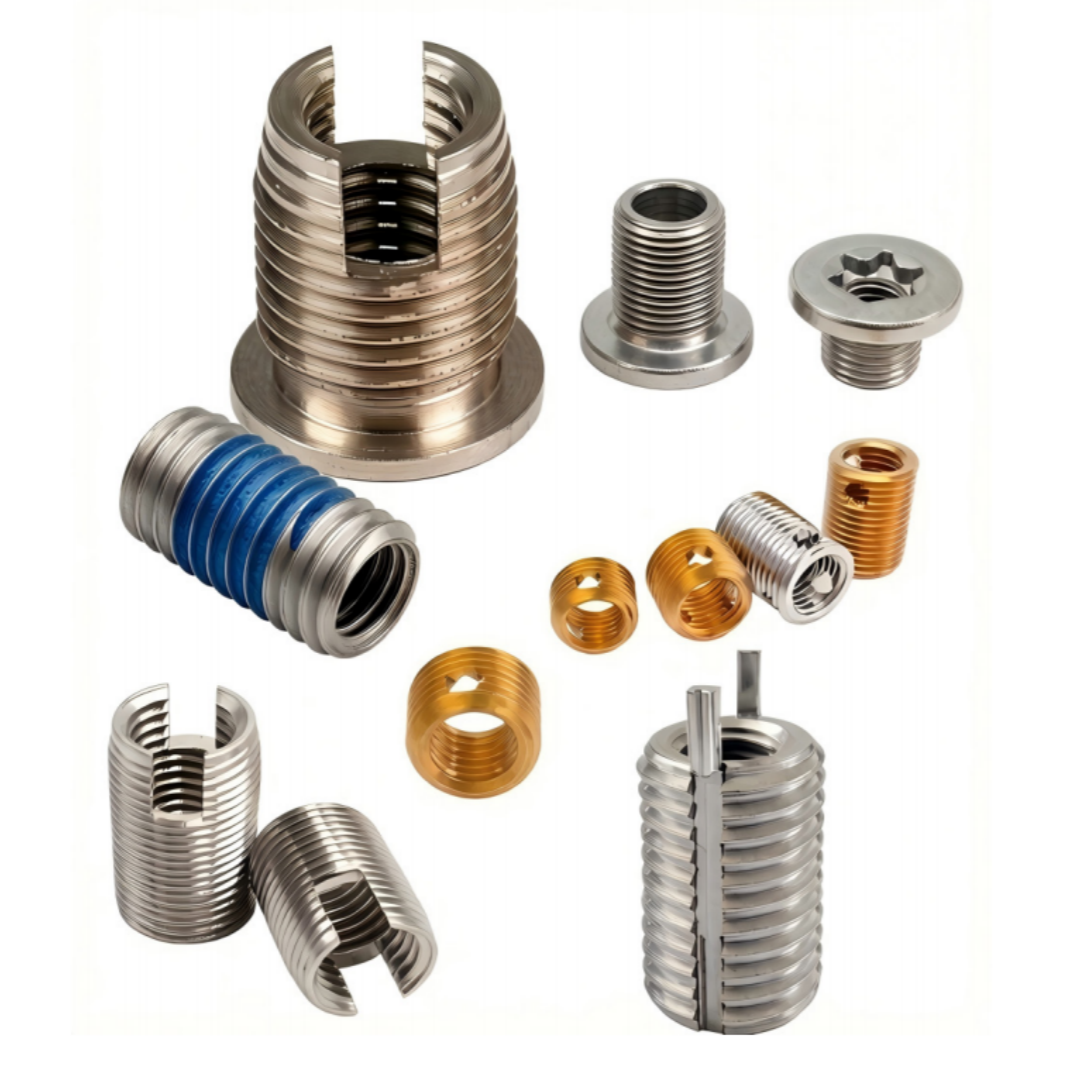
3.4 Key Locking Insert
A solid bushing-type insert with internal and external threads, with a wedge or "key" attached at the top. It can effectively distribute load, repair or reinforce threads, thereby preventing failures caused by flaking, galling, or corrosion.
Typical applications: high-torque, high-temperature environments, and fastening scenarios requiring frequent disassembly and reassembly (such as aero engines, jigs, and molds).
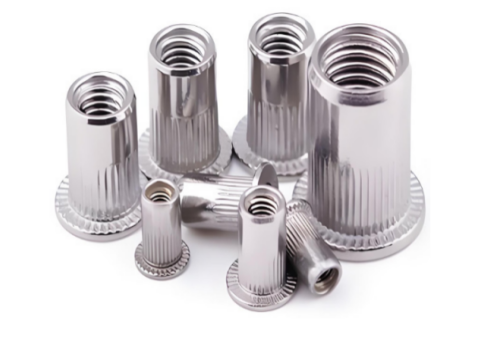
3.5 Knurled Flange Insert
A thread repair/enhancement fastener with a flange and "knurled" external profile. It is essentially a high-strength internal threaded sleeve, pressed into a pre-machined substrate hole via a dedicated tool to form a newer, stronger, and more durable internal thread.
Key to selection — look at the substrate material:
| Substrate Type | Applicable? | Typical Representatives |
| Ideal Substrate | ✅ Applicable | 6061, 6063 series aluminum alloys, magnesium alloys, zinc alloys, engineering plastics, dense wood, etc. (good plasticity allows the knurls to press in effectively, forming a firm interference fit) |
| Unsuitable Substrate | ❌ Avoid | 7075 and other heat-treated high-strength aluminum alloys, as well as steel, cast iron, titanium alloys, etc. (too hard for the knurls to press in, may damage the tool or deform the insert) |
Alternative: For high-strength, high-hardness substrates, ordinary wire inserts (helical coil inserts) or threaded bushings that rely on substrate thread engagement should be selected.
3.6 Internal/External Threaded Bushing
Used to create wear-resistant threaded joints with good load-bearing capacity in formed parts made of light alloys, cast iron, and steel. Suitable for through-holes and blind holes.
How to choose the length? Rule of thumb: Recommended length ≈ 2 × nominal screw diameter (A).
Example: Workpiece shear strength ≈ 140 N/mm², screw M6, strength grade 8.8. Recommended length = 2A = 2 × 6 mm = 12 mm.
4. Installation Method
When the number of installations is large, it is recommended to use a dedicated insert installation tool. The tail end of the tool is a hex head, which can:
Connect to a manual tapping wrench (small batches, repair);
Connect to electric or pneumatic tools (mass production, improved efficiency).
Correctly selecting the installation tool and maintaining coaxiality is the prerequisite for ensuring the insert is pressed/screwed into place and forms an effective interference fit or engagement.
5. Industry Applications and Cost Perspective
Thread inserts are widely used in machinery, automotive, aerospace, electronics, molds, and marine equipment. Wherever there is a "soft substrate + reliable threaded connection," they have a role to play.
From the perspective of enterprise R&D and manufacturing management, thread selection hides two often-overlooked "pitfalls":
Project Lifecycle Cost Impact Model: The early decision window is extremely short yet locks in most of the cost; later correction costs are extremely high, and risks and returns are easily mismatched. Therefore, precise judgments on fastening solutions must be made at the very early stage.
15–85 Rule: Enterprises often over-focus on the visible "procurement cost" while ignoring the approximately 85% of hidden costs (design, supply chain, after-sales, rework, quality claims, etc.). Early decision errors will significantly drive up the total lifecycle cost.
Incorporating thread inserts into early design is precisely using minimal upfront investment to avoid the high costs of later failures and rework.
6. One-Stop Technical Support from Yongjing Precision
As a professional fastener manufacturer, Yongjing Precision provides full-chain support from prototype to after-sales around thread inserts and fastening connections:
Rapid engineering prototypes — shorten validation cycles;
Professional design consultation — assist with selection and structural adaptation;
Professional testing services — verify vibration resistance, pull-out resistance, corrosion resistance, and other performance;
Professional training — empower installation processes and on-site standards;
Continuous process optimization — match production tempo and yield requirements;
Professional teardown analysis — failure attribution and improvement suggestions.