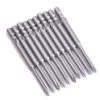
Toprecision: Hydrogen embrittlement in bolts stems from material, hydrogen sources, and tensile stress.
In critical sectors such as wind turbine towers, automotive chassis, and chemical equipment, bolt failures caused by hydrogen embrittlement are a recurring issue. Each fracture can lead to production shutdowns, safety hazards, or even catastrophic accidents, resulting in incalculable losses. As Yongjing Precision, a company with years of deep expertise in precision fasteners, we have witnessed too many tragedies caused by hydrogen embrittlement. We have also noticed a peculiar pattern: these accidents almost exclusively involve high-strength bolts, such as Grade 12.9 and 10.9, while lower-strength bolts like Grade 4.8 and 6.8 rarely suffer from this issue.
Many of our clients and industry peers have asked Yongjing Precision: Why are high-strength bolts, which are supposedly "stronger," actually more "fragile"? Today, leveraging our extensive industry experience, Yongjing Precision will explain the underlying logic, triggering conditions, and prevention methods of hydrogen embrittlement in plain language. This guide is packed with practical insights for production, procurement, and maintenance professionals. Read on to avoid pitfalls, select the right components, and connect with Yongjing Precision's customized solutions to precisely mitigate hydrogen embrittlement risks.
Consider these alarming statistics: Industry data shows that over 80% of high-strength bolt fracture accidents are caused by hydrogen embrittlement. Among these, Grade 12.9 bolts account for over 60%, and Grade 10.9 bolts account for about 30%, primarily concentrated in critical load-bearing scenarios like wind power, automotive chassis, and chemical equipment. While these accidents may seem accidental, they are actually the inevitable result of the combined effects of material, environment, and mechanical forces. All three factors are indispensable, which forms the core prevention logic when Yongjing Precision provides fastener solutions to our clients.
Yongjing Precision is committed to "providing products and solutions that earn customer trust, enhancing product performance, and reducing total costs for our clients." Today, we will dissect the truth behind hydrogen embrittlement from a professional perspective, helping you mitigate risks at the source and select the most suitable precision fasteners.
01 Decoding the Truth of Hydrogen Embrittlement: 3 Necessary Conditions
Many mistakenly believe that hydrogen embrittlement is simply a result of "poor material quality." In reality, even imported high-strength bolts can suffer brittle fractures if these three conditions are met. Based on years of production and R&D experience, Yongjing Precision has identified these three core conditions. Understanding them can help you avoid 80% of hydrogen embrittlement risks at the source, and they serve as the core entry point for our customized solutions.
Condition 1: Susceptible Materials – The "Inherent Weakness" of High-Strength Bolts.
Hydrogen embrittlement is highly selective; not all bolts are vulnerable. Quenched and tempered carbon steel with a strength grade ≥ 8.8 is the "hardest hit" area, with Grade 10.9 and 12.9 posing the highest risks. After quenching and tempering, these steels form martensite or tempered martensite structures. The crystal lattice is riddled with defects like dislocations and vacancies, acting as pre-set "traps" for hydrogen atoms. Once hydrogen invades, it gets trapped and cannot easily escape.
Conversely, Grade 4.8 and 6.8 low-strength bolts are made of low-carbon steel. With lower strength and fewer lattice defects, hydrogen atoms struggle to stay, drastically reducing susceptibility. Yongjing Precision advises peers and procurement partners: For critical load-bearing applications, do not blindly pursue high strength. Unless承受超大载荷 (extreme loads) are required, Grade 8.8 or below is safer. This is a core logic in our product recommendations, balancing functional needs with risk mitigation.
Condition 2: Hydrogen Source Intrusion – Surface Treatment is the "Primary Danger Zone".
Hydrogen atoms do not appear out of thin air; they must intrude into the steel matrix. In industrial production, surface treatment is the main source of hydrogen, especially electroplating. Whether zinc or zinc-nickel plating, the pre-treatment acid pickling and cathodic electroplating processes generate massive amounts of hydrogen atoms. Strong acid cleaning continuously releases hydrogen through corrosion reactions, and during cathodic electroplating, the current directly drives H⁺ reduction into hydrogen atoms, some of which seep into the bolt's lattice.
More insidiously, even if no hydrogen is introduced during manufacturing, the service environment can become a long-term hydrogen source. Damp salt spray in wind power, hydrogen sulfide in chemical equipment, and rainwater corrosion on automotive chassis continuously generate hydrogen atoms that slowly intrude into the bolt, hiding embrittlement risks. This is why Yongjing Precision always inquires about usage scenarios and surface treatment needs when engaging with clients. Precise process matching is key to preventing future accidents and fulfilling our mission to "enhance product performance."
Condition 3: Tensile Stress Drive – The "Invisible Magnet" for Hydrogen Atoms.
A core characteristic of hydrogen embrittlement is that it only occurs under tensile stress; compressive stress will not trigger it. The original design intent of high-strength bolts is to bear heavy loads, with preload often exceeding 90% of the yield strength. Combined with a stress concentration factor of 3-5 at the thread root, this creates a localized high-stress field.
This high-stress field acts like a powerful magnet, firmly attracting hydrogen atoms that have intruded into the lattice to the areas of maximum stress. Hydrogen atoms accumulate densely at grain boundaries or inclusions. Once accumulated to a certain extent, hydrogen-pressure cracks form. As stress continues, the cracks propagate rapidly, ultimately causing delayed fracture. This explains why hydrogen embrittlement accidents often occur hours to months after bolt assembly, exhibiting extreme concealment. Yongjing Precision's precision fasteners minimize stress concentration through process optimization to mitigate this risk.
Additionally, temperature is a crucial factor—room temperature is the most dangerous window for hydrogen embrittlement. At very low temperatures (<-50°C), hydrogen atom diffusion stagnates and cannot accumulate. At high temperatures (>100°C), hydrogen atoms escape faster, preventing embrittlement. This is especially important in extreme temperature scenarios like chemical and wind power applications, serving as a vital basis for Yongjing Precision's customized solutions.
02 In-Depth Analysis: Why Are High-Strength Bolts More "Fragile"?
Having understood the triggering conditions, let’s address the most pressing question: Why does higher strength lead to easier brittle fracture? Based on years of production and R&D experience, Yongjing Precision has summarized the core reason: the vicious cycle of "strength, microstructure, and stress." This is a key concept we emphasize in our client selection training to quickly build professional trust.
First, the Hardness Threshold Effect: HRC 32 is an Insurmountable Red Line.
Material hardness and hydrogen embrittlement susceptibility have an exponential relationship. The industry-recognized critical value is HRC 32: Grade 8.8 bolts (HRC 22-32) are near the warning line, Grade 10.9 (HRC 32-39) clearly exceeds it, and Grade 12.9 (HRC 39-44) is in the high-risk zone. Increased hardness reduces grain boundary cohesion. After hydrogen atoms segregate at grain boundaries, even low external stress can trigger intergranular fracture. When producing high-strength bolts, Yongjing Precision strictly controls hardness to stay within the HRC 32 red line, balancing strength and susceptibility.
Second, High Tensile Stress Accelerates Hydrogen Enrichment.
The design intent of high-strength bolts is to bear heavy tensile loads, but this becomes a catalyst for hydrogen embrittlement. High stress not only provides the driving force for crack propagation but also enhances hydrogen atom concentration at the crack tip by tens of times through stress-induced diffusion, forming a vicious cycle of "hydrogen pressure-cracking-hydrogen enrichment," ultimately leading to brittle fracture. Yongjing Precision optimizes bolt structural design to reduce stress concentration at the thread root, alleviating this cycle and improving product stability.
Third, Insufficient Plastic Reserve: Brittle Fracture Without Warning.
High strength comes with low toughness. The elongation after fracture for Grade 12.9 bolts is typically ≥8%, while Grade 8.8 bolts are ≥12%. Although the difference seems small, in hydrogen embrittlement scenarios, the stress-strain curve of high-strength steel lacks a distinct yield plateau, and local plastic deformation capacity drops sharply. This means that once micro-cracks appear, there is almost no plastic deformation buffer. Cracks propagate at millisecond speeds, with no necking warning before fracture, making it highly concealed and sudden. Yongjing Precision selects high-quality medium-carbon alloy quenched and tempered steel and optimizes heat treatment processes to enhance toughness while maintaining strength, reducing brittle fracture risks.
03 Yongjing Precision Practical Guide: 4 Strategies to Completely Prevent Hydrogen Embrittlement Risks
As a deep-rooted player in the precision fastener field, Yongjing Precision aims to "become the TOP1 brand in niche industries and achieve global leadership in single-product technology." Combining years of production, R&D, and customer service experience, we have summarized 4 hydrogen embrittlement prevention strategies covering material selection, process, and design. These can be directly implemented to help enterprises completely avoid hydrogen embrittlement risks and reduce production costs.
3.1 Surface Treatment: Prioritize Hydrogen-Free Processes to Reduce Hydrogen at the Source.
Electroplating is the largest controllable hydrogen source and requires thorough reform. Yongjing Precision prioritizes solid-state coating processes like mechanical galvanizing and zinc-aluminum coating (Dacromet), which involve no electrolytic hydrogen evolution, eliminating hydrogen embrittlement risks at the source while enhancing corrosion resistance for complex scenarios like wind power and chemicals. If electroplating is mandatory, Yongjing Precision shortens pickling time, prohibits repeated rework, and ensures hydrogen removal treatment within 1 hour post-plating to minimize hydrogen intrusion.
3.2 Hydrogen Removal Baking: Strictly Adhere to Timing for Efficient "Detoxification".
Hydrogen removal is a life-saving process after electroplating, but the window is extremely short. Once hydrogen diffuses deeply, baking can hardly remove it. Based on the characteristics of different strength bolts, Yongjing Precision has standardized hydrogen removal parameters: baking at 200±10°C, ≥2 hours for Grade 10.9 bolts, and ≥3-4 hours for Grade 12.9 bolts. Crucially, we strictly follow the sequence of "hydrogen removal first, passivation second." The passivation film acts as a seal; if passivated before hydrogen removal, hydrogen atoms are "suffocated" inside the steel, producing the opposite effect. This is a core detail in Yongjing Precision's strict quality control.
3.3 Material Selection: Balance Strength and Hydrogen Embrittlement by Choosing Suitable Materials.
Yongjing Precision prioritizes medium-carbon alloy quenched and tempered steels like 42CrMo and 35CrMo, using high-temperature tempering to obtain a tempered sorbite structure. This structure has low hydrogen trap density and good plasticity, balancing strength and hydrogen embrittlement for most critical load-bearing scenarios. We strictly prohibit the use of high-carbon tool steels or high-hardness steels with insufficient low-temperature tempering, reducing hydrogen embrittlement susceptibility at the source to ensure product reliability.
3.4 Design Optimization: Control Stress to Enhance Product Stability.
When providing customized solutions, Yongjing Precision advises clients to reduce preload to 70-80% of the yield strength, avoiding excessive tightening that exacerbates stress concentration. For electroplated surface treatments, we prioritize recommending Grade 8.8 or below bolts to reduce hydrogen embrittlement susceptibility at the source. Additionally, we introduce shot peening to create a residual compressive stress layer on the bolt surface, offsetting tensile stress and effectively inhibiting the initiation and propagation of hydrogen embrittlement cracks.
04 Yongjing Precision Summary: Reject "Stronger but More Fragile"; Precise Prevention is Key
The hydrogen embrittlement of high-strength bolts is essentially a fundamental contradiction between the "demand for high strength" and "hydrogen embrittlement susceptibility." The solution lies not in blindly pursuing higher strength, but in establishing a full-chain prevention mindset. This is the product philosophy Yongjing Precision has upheld for years: we do not blindly pursue extreme parameters but precisely match client scenario needs, providing precision fastener solutions that are "performance-adapted and cost-optimal."
Yongjing Precision believes that preventing hydrogen embrittlement focuses on three points: adhering to the HRC 32 hardness red line in material selection, avoiding electroplating and strictly adhering to hydrogen removal timing for high-strength bolts in processing, and reasonably controlling stress levels in design. Only by translating material science knowledge into executable process specifications can we avoid "major accidents caused by bolt fractures." For critical load-bearing parts, appropriately lowering the strength grade and selecting zinc-aluminum coatings is often a wiser choice, reducing both risk and cost, aligning with Yongjing Precision's mission to "reduce total costs for clients."














 Login
Login











 Contact
 WeChat
 粤ICP备2025493240号-1