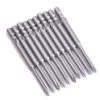
Titanium Fasteners: Pros, Cons & Best Uses
Titanium alloy fasteners: widely used in aerospace, medical, and marine. Pros and cons equally important — proper matching is key.
As critical connecting components in high-end manufacturing, titanium alloy fasteners are widely used in aerospace, medical, and marine engineering due to their unique material properties. Their performance advantages and application limitations are equally prominent; accurately grasping their pros and cons is essential for efficient application matching. The following is a detailed multi-dimensional analysis.
Core Advantages: Performance Highlights for High-End Applications
High specific strength and lightweight properties are the most prominent advantages of titanium alloy fasteners. With a density of only 4.5g/cm³ (less than 60% of steel), they can achieve a 40%-50% weight reduction for the same specifications. Meanwhile, their tensile strength can reach 900-1400MPa, comparable to Grade 10.9 high-strength steel, and their specific strength is 2.2 times that of steel. This characteristic is crucial in aerospace, effectively reducing the dead weight of aircraft and improving range and payload capacity. It is also an ideal choice for lightweight design in automotive unsprung components.
Titanium alloy fasteners possess extremely strong corrosion resistance and stability, requiring no additional coating protection. In environments such as body fluids, seawater, and acids/alkalis, they can automatically form a dense titanium dioxide protective film to prevent corrosion penetration, with an annual corrosion rate of less than one-thousandth of a human hair's diameter. In marine engineering, they can resist erosion in high-salt environments; in the medical field, relying on excellent biocompatibility, they achieve "biological integration" with human bone tissue, making them core materials for orthopedic implants and dental implants.
High and low-temperature adaptability and non-magnetic properties further expand their application boundaries. They maintain stable performance within a temperature range of -100℃ to 400℃, with the yield strength of some grades slightly increasing at low temperatures, making them suitable for extreme environments like space and superconductivity. Their non-magnetic nature ensures they are free from magnetic interference in precision electronics and military equipment, avoiding any impact on instrument accuracy.
Inherent Limitations: Core Bottlenecks Restricting Widespread Adoption
High costs are the primary obstacle to the large-scale popularization of titanium alloy fasteners. Raw materials are inherently expensive, and processing is extremely difficult. Due to their low thermal conductivity, heat easily accumulates locally during machining. This requires low-speed cutting combined with liquid nitrogen cooling and leads to rapid tool wear. Processing costs are several to dozens of times the material value. The final selling price is about 5-10 times that of ordinary steel fasteners, and they mostly require customization with very few available in stock.
Low-temperature performance varies, and plastic strengthening capacity is insufficient. Experiments show that at -100℃, the mechanical properties of different fastener models like M8 and M10 vary. The proof load performance grades of some models drop by 1-2 levels, plastic strengthening capacity generally decreases, and the risk of fracture increases, necessitating targeted material selection.
Auxiliary performance shortcomings and strict installation requirements. Titanium alloys have poor electrical conductivity and are prone to galvanic corrosion during installation, requiring additional insulation measures. They are sensitive to stress corrosion at high temperatures and exhibit notch sensitivity. If minor defects occur during processing and installation, they can easily cause edge chipping and deformation, affecting connection stability.
Conclusion: Precise Matching is Key to Demonstrating Value
The advantages of titanium alloy fasteners are concentrated on the rigid performance demands of high-end scenarios, while their disadvantages revolve around costs and processing thresholds. In fields where performance requirements far outweigh cost considerations, such as aerospace, medical, and high-end equipment, their irreplaceability is prominent. However, in scenarios pursuing cost-effectiveness, such as general machinery and civil construction, they still cannot replace steel or aluminum alloy fasteners. In the future, with the upgrading of processing technologies, if costs can be reduced and low-temperature performance optimized, their application scope is expected to be further expanded.
If you have special fastener requirements or technical issues, please feel free to contact us through our official website or WeChat official account at 13560730094. Our technical team will provide you with professional consulting services.




























 Login
Login












 Contact
 WeChat
 粤ICP备2025493240号-1