Spring lock washers stop bolt loosening via elastic deformation — small but critical.
Spring lock washers, formally known as elastic washers, are indispensable basic fastener accessories in mechanical connections. Their core function is to utilize their own elastic deformation to counteract bolt loosening caused by factors such as vibration and temperature differences, thereby ensuring the stability and reliability of the connection structure. Despite their compact size, the selection and application of spring lock washers directly affect the operational safety and service life of equipment in numerous fields, including mechanical manufacturing, the automotive industry, and home appliance production. Their importance cannot be overlooked.
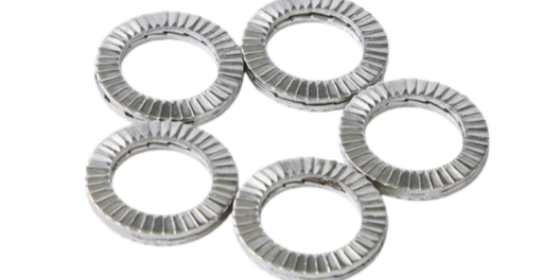
From a structural design perspective, the core advantage of spring lock washers stems from their unique split-ring structure and elastic properties. Common spring lock washers typically feature a single-loop split design with a trapezoidal or rectangular cross-section. During assembly, they are placed over a bolt or screw. Once the nut is tightened, the washer undergoes elastic deformation under axial pressure, generating a continuous axial preload. This increases the friction between the bolt and the connected parts, thereby preventing loosening caused by vibration, impact, or thermal expansion and contraction. For certain special applications, variants such as multi-loop washers or wave washers are used to accommodate different load requirements and installation spaces.
Material selection is crucial in determining the performance of spring lock washers and must be matched to specific operating conditions. Currently, mainstream materials are primarily spring steels, such as 65Mn and S60C. After heat treatment, these materials possess excellent elasticity, toughness, and wear resistance, allowing them to withstand repeated deformation without failing, making them suitable for most general mechanical applications. For harsh environments involving moisture or corrosion, stainless steel materials (such as 304 and 316) are selected due to their outstanding rust and corrosion resistance, which prevents connection failure caused by washer corrosion. Additionally, high-temperature-resistant alloys are used in high-temperature conditions to ensure the washer maintains stable elasticity.
Spring lock washers have a wide range of applications, covering both heavy and light industries as well as daily consumer sectors. They are primarily suited for connections requiring anti-loosening and anti-vibration properties. In the automotive industry, they are used in critical components like engines, chassis, and wheels to withstand high-frequency vibrations during driving and prevent safety hazards caused by bolt loosening. In mechanical manufacturing, they are used in the housing and base connections of equipment such as machine tools and motors to counteract operational vibrations and ensure equipment precision and stability. In home appliance production, internal connections in washing machines and air conditioners also utilize spring lock washers to prevent loosening and abnormal noises after long-term use. Meanwhile, in high-end fields such as aerospace and rail transit, the material and precision requirements for these washers are much higher, needing to meet stringent reliability standards.
The rationality of selection and installation directly determines the anti-loosening effectiveness of spring lock washers. During selection, bolt specifications, load magnitude, and operating conditions must be considered: the bolt specification must match the inner diameter of the washer; a size that is too large can cause misalignment, while a size that is too small will fail to achieve effective deformation. For high-load scenarios, thicker and more elastic washers should be selected to prevent failure due to excessive deformation. Special operating conditions, such as corrosion or high temperatures, require precise matching of corresponding materials. During installation, the washer must fit tightly against the surface of the connected part without any trapped debris. The tightening force must be moderate; overtightening will cause plastic deformation and loss of elasticity, while undertightening will fail to generate sufficient preload.
During use, spring lock washers are prone to common issues such as elastic failure, rust, and fracture, which require targeted prevention and treatment. Elastic failure is mostly caused by material mismatch, excessive loads, or fatigue aging from long-term use; this requires replacing the washer with one of the appropriate material and specification, along with regular inspections. Rust mainly results from corrosive operating conditions or improper material selection and can be resolved by using corrosion-resistant materials and applying surface rust-prevention treatments. Fracture is usually caused by installation deviations or material defects, necessitating standardized installation procedures and the use of qualified products.
















 Login
Login












 Contact
 WeChat
 粤ICP备2025493240号-1