




















 Login
Login



Products
Solutions
Applications





Driven by the "dual carbon" goals, lightweighting has become a core imperative across the automotive, aerospace, and consumer electronics industries. As critical components for fastening connections, the material innovation of bolts is quietly reshaping the industry landscape. With over two decades of deep expertise in precision fasteners, Yongjing Precision (parent company: Yingfeng Zhichengjia) has achieved a series of breakthroughs in the R&D and manufacturing of high-strength aluminum alloy bolts, offering customers total cost optimization solutions from design to after-sales service.
I. Why Aluminum Alloy Bolts?
Traditional steel bolts have a density of approximately 7.85 g/cm³, while aluminum alloy bolts have a density of only about 2.7 g/cm³, achieving weight reduction of over 60%. This advantage is particularly prominent in the new energy vehicle sector—lighter fasteners mean lower overall vehicle weight and extended driving range.
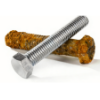
Beyond lightweighting, aluminum alloy bolts address another industry pain point: galvanic corrosion. When steel bolts are used to connect magnesium or aluminum alloy components, the significant potential difference makes them highly susceptible to galvanic corrosion. In contrast, aluminum alloy bolts have a potential close to that of magnesium/aluminum components, effectively mitigating this issue. According to the principle of galvanic corrosion, the greater the potential difference between two metals, the stronger the corrosion tendency.
[Image]
II. Technical Breakthroughs: From Materials to Processes
1. Material Formulation and Performance
Yongjing Precision's high-strength aluminum alloy bolts are developed in reference to the Volkswagen Group standard VW60469, utilizing the AW6056 (AlSiMgCuMn) alloy grade. Through material optimization, they achieve an ultimate tensile strength of 630 MPa and a yield strength of 500 MPa. Test data shows that the ZT68 material delivers a stable ultimate tensile strength of approximately 630 MPa, a yield strength of around 500 MPa, and an elongation at break of ≥6%.
This performance level means that aluminum alloy bolts can already meet the stringent strength requirements of automotive powertrain systems.
2. Innovative Cold Heading Process
Traditional aluminum alloy fasteners are often manufactured using CNC machining, which suffers from low material utilization and efficiency. Yongjing Precision pioneered the mass production of high-strength aluminum alloy bolts via the cold heading process in China. The advantages of cold heading include:
Material utilization rate increased to over 90%, significantly higher than machining
Production efficiency boosted by over 30%, with comprehensive cost reduction of 15%
One-step forming, ensuring excellent product consistency
As General Manager Xu Chaokui stated: "This process is a domestic first. Products made through cold heading offer high strength, high production efficiency, material savings, and one-step forming."
3. Heat Treatment and Thread Rolling
The performance of aluminum alloy bolts relies on precise heat treatment control. Solution treatment (480–530°C) fully dissolves alloying elements into the aluminum matrix, followed by aging treatment at 150–200°C to precipitate finely dispersed strengthening phases—this is the key to achieving high strength.
It is particularly worth emphasizing that Yongjing Precision requires thread rolling to be performed after heat treatment, rather than before. The advantages of this process sequence are:
Improved mechanical properties of the threads
Reduced susceptibility to intergranular corrosion
Formation of compressive residual stress in the thread root, enhancing fatigue strength
Reduced risk of thread damage
4. Short Engagement Length Advantage
Due to the material properties of aluminum alloys, when aluminum bolts are used in magnesium/aluminum components, the engagement length required is only 1.3–1.5d (where d is the nominal thread diameter), whereas steel bolts typically require 2–3d. Shorter engagement length means a more compact design envelope and lighter structural weight.
III. Rigorous Validation: Data-Driven Reliability
Yongjing Precision conducted systematic performance tests on ZT68 aluminum alloy bolts:
Room Temperature Tensile Properties: Ultimate tensile strength average of 633 MPa, yield strength of 540 MPa, and elongation of approximately 8.5%
Performance Retention After Thermal Exposure:
After 150°C × 6h thermal exposure: 97.1% retention
After 150°C × 8h thermal exposure: 96.3% retention
After 150°C × 12h thermal exposure: 95.5% retention
Galvanic corrosion comparative testing shows that when aluminum alloy bolts are connected to magnesium alloy, no significant corrosion is observed around the hole; however, steel bolts under the same conditions show visible corrosion pits and severe peeling of the magnesium alloy matrix at the hole edges. This is a direct manifestation of the smaller potential difference between magnesium and aluminum, versus the larger potential difference between magnesium and iron.
IV. Industry Applications and Market Recognition
Currently, Yongjing Precision's high-strength aluminum alloy bolts have entered the supply chains of leading new energy vehicle manufacturers including BYD, Geely, and CATL, with orders remaining at full capacity and shipment volume growing 30% year-over-year. The company has accumulated 26 authorized patents and holds over 20% of the domestic market share for precision electronic fasteners.
The company has also established industry-university-research partnerships with Shenzhen University, Southern University of Science and Technology, Sun Yat-sen University, and other institutions, with annual R&D investment exceeding 10 million RMB, continuously driving the iterative advancement of high-strength aluminum alloy materials.
V. Value Proposition: Beyond Connection
Yongjing Precision's parent company, Yingfeng Zhichengjia, has proposed the "15-85 Rule" —the procurement cost of fasteners accounts for only 15% of the total lifecycle cost, while 85% of costs come from hidden elements such as design, supplier selection, logistics, warehousing, inspection, pre-assembly, assembly, and after-sales service.
Therefore, what we offer our customers is not just a product, but a comprehensive total cost optimization service from prototype design to after-sales, including:
Professional design consultation and collaborative engineering
Rapid engineering samples (as fast as 1-day delivery)
Professional testing services
Continuous process optimization
Professional disassembly analysis and material consolidation
Micro Screws, Macro Solutions:
Download
Fastener Tech: The Core of Smar
Download
Precision Fastener Technology
Download
Toprecision Mall Launches
Download
Fastener Technology: Material S
Download
Why Titanium Alloys are the Pre
Download
China's 100-Billion-Yuan Commer
Download
Core Tech Analysis: Precision F
Download

Need Customized Documents? Get Exclusive Precision Fastener Technical Solutions!
Consult NowNeed Customized Documents? Get Exclusive Fastener Technical Solutions!
Consult NowProducts
Solutions
Applications
Contact
 Contact
 WeChat
Contact: Manager Fan - Tel/WeChat: 135-6073-0094 Email: Flora.Fan@toprecision.com | Manager Ao - Tel/WeChat: 13560729614 Email: Olia.Ao@toprecision.com
Sales Director: Mr. Zhang - Tel: 13510369429 Email: xiaowei.zhang@zcjtech.com
© Copyright 2011 - 2026 Shenzhen Toprecision Precision Technology Co., Ltd. All Rights Reserved.
 粤ICP备2025493240号-1

Cutter Screws
Thread Inserts
Sealing Products
Riveting Products
Locking Products
Direct Assembly
SMT Components
Precision Screws
Screwdriver Bits