























 Login
Login



Products
Solutions
Applications





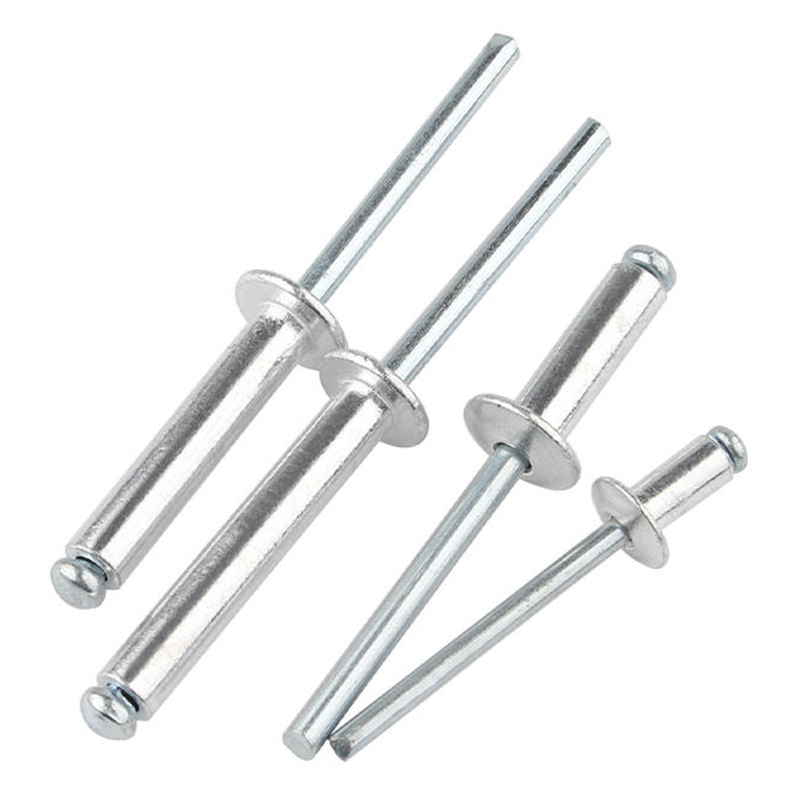
In many fields—including aerospace, automotive manufacturing, and architectural decoration—there are numerous riveting scenarios where "only one side is accessible and the back side is not operable." Conventional rivets are inadequate for such situations, but blind rivets, with their core advantage of "single-sided riveting," have become the preferred fastener for these applications. As the mainstream type of blind fastener, blind rivets not only offer high connection strength, reliability, and long service life, but are also compatible with various base materials such as aluminum alloys, structural steel, and composite materials. They are indispensable in the riveting of inaccessible areas of aircraft and in equipment maintenance. This article provides a comprehensive overview of blind rivets from four perspectives: structural analysis, working principles, core advantages, and industry applications.
I. Precision Structure: A Fastening Foundation Built on Four Collaborative Components
The superior performance of blind rivets stems from their precision four-component design—rivet stem, rivet sleeve, locking collar, and top washer—each with its own distinct function, working in synergy to achieve stable and reliable connections. The structural details of each component are precisely engineered and directly affect the riveting outcome.
The rivet stem is the core load-bearing component of the blind rivet. It is made from high-strength carbon steel, stainless steel, or aluminum alloy, with the material selected according to the strength requirements of the application. Its structure incorporates three key design features: a serrated head that enhances the gripping force with the rivet sleeve to prevent loosening due to vibration after riveting; a precisely positioned break neck groove in the middle of the shank, which is the core structure controlling the fracture location of the stem, ensuring that the excess portion of the stem breaks cleanly after riveting without affecting the surface flatness of the workpiece; and a shear ring near the head that serves as a force transmission buffer, evenly distributing tensile force during the pulling process to prevent premature stem fracture caused by localized overloading.
The rivet sleeve is the component that directly contacts the workpiece. It is made from materials with good ductility, such as pure aluminum, aluminum alloy, or copper alloy, to facilitate plastic deformation under pressure. A tiny internal cavity is预留 at the end of the sleeve before forming. This design is the key to achieving "locking"—when the locking collar deforms during riveting, it precisely embeds into and fills this cavity, forming a robust mechanical interlocking structure. Additionally, the sleeve surface is typically treated with anti-corrosion finishes such as zinc plating or passivation to enhance its resistance to corrosion in humid environments.
The locking collar is the core component that ensures anti-loosening performance. It is typically made of spring steel or elastic alloy and is precisely fitted onto the break neck groove of the stem during assembly. After riveting is completed, the locking collar permanently deforms and becomes wedged between the stem and the sleeve, locking their relative positions from the inside. This effectively prevents separation of the stem and sleeve even in vibrating environments—a key reason why blind rivets are more reliable than ordinary blind fasteners. Visually, after riveting, the locking collar remains exposed at the center of the rivet head, serving as an intuitive indicator of proper riveting.
The top washer, though simple in structure, is critical to riveting stability. Made of hard metal and assembled at the end of the sleeve, it serves as the reference force-bearing surface during rivet gun operation. When the rivet gun pulls the stem, the top washer evenly transmits the gun's reaction force to the workpiece surface, preventing local pressure concentrations that could cause indentations or damage to the workpiece, while also ensuring uniform sleeve deformation and improving joint sealing.
II. Working Principle: The Fastening Logic of Pulling and Deformation
The core advantage of blind rivets—"single-sided riveting"—derives from their unique four-step working sequence: "pull–deform–lock–break." The entire process is completed using a rivet gun operated from a single side, offering convenience and high efficiency.
Step 1: Positioning and Insertion. The blind rivet is inserted as a whole into the pre-drilled hole of the workpieces to be joined, ensuring that the sleeve fully contacts the workpiece surface and the top washer is in close contact with the workpiece. At this point, the serrated head of the stem is engaged with one end of the sleeve, and the locking collar is positioned between the break neck groove and the sleeve cavity, with the entire assembly ready for riveting. The diameter of the pre-drilled hole must precisely match the rivet specification—typically 0.1–0.3 mm larger than the sleeve's outer diameter. An oversized hole can lead to looseness after riveting, while an undersized hole may prevent smooth insertion of the sleeve.
Step 2: Pulling Force Application. The nose piece of a dedicated rivet gun is fitted over and clamped onto the exposed end of the stem. Upon activation, the rivet gun applies an axial tensile force to the stem. Because the top washer is in firm contact with the workpiece and cannot move, the pulling force on the stem causes the sleeve to contract toward the top washer. At the same time, constrained by the wall of the workpiece hole, the sleeve begins to expand radially, gradually filling the pre-drilled hole and conforming to the workpiece surface.
Step 3: Locking and Formation. As the stem continues to be pulled, the radial expansion of the sleeve progressively reduces the space within its internal cavity, compressing the locking collar fitted on the break neck groove and causing it to undergo plastic deformation. Eventually, the locking collar becomes fully embedded into the sleeve cavity while simultaneously engaging with the break neck groove of the stem, firmly locking the stem and sleeve together to form a non-detachable connection. At this stage, the sleeve has fully deformed and closely conforms to the workpiece surface, achieving stable fastening.
Step 4: Stem Break and Finish. When the rivet gun's pulling force reaches a preset value, the stem fractures cleanly at the designed break neck groove. The excess stem remnant is pulled out by the rivet gun's nose piece, completing the riveting process. The fractured head surface is flush, and the locking collar is exposed at the center, providing a visual confirmation that the riveting is properly completed. The entire process takes only 3–5 seconds and can be performed by a single operator, significantly improving riveting efficiency.
III. Core Advantages: Performance Support for Diverse Scenarios
The widespread application of blind rivets across numerous industries is attributable not only to their "single-sided riveting" capability but also to their high connection strength, strong adaptability, ease of operation, and other advantages that perfectly align with the efficient production demands of modern manufacturing.
The single-sided operation advantage is their most critical competitive edge. In scenarios where the back side is inaccessible—such as connecting aircraft fuselage skins to frames, fixing internal components of automobile doors, or installing suspended ceiling tracks—conventional rivets require access from both sides to complete the riveting. Blind rivets, by contrast, only need to be inserted from one side and operated with a rivet gun, eliminating the need for a second operator on the back side and greatly reducing construction difficulty. This advantage is especially pronounced in confined spaces, high-altitude work, and similar challenging environments.
Connection reliability and strength performance are excellent. Through the mechanical interlocking of the locking collar with the sleeve and stem, combined with radial expansion filling of the sleeve, blind rivets form a multi-layered locking structure with vibration resistance far exceeding that of ordinary blind fasteners. Tests show that standard-spec blind rivets can achieve tensile strengths of 10–50 kN and shear strengths of 5–30 kN, meeting the connection requirements of most structural components. Additionally, their service life is long—under normal operating conditions, they can last as long as the workpieces themselves, reducing long-term maintenance costs.
Exceptional adaptability is another major highlight. In terms of materials, the appropriate rivet type can be selected based on the base material characteristics—for example, aluminum-sleeve rivets for joining aluminum workpieces and stainless steel rivets for stainless steel workpieces, preventing electrochemical corrosion. In terms of specifications, blind rivets range from 2 mm diameter micro-rivets to 12 mm diameter heavy-duty rivets, covering a wide variety of sizes to accommodate workpieces of different thicknesses and materials. Furthermore, some specialized blind rivet variants also offer sealing performance, achieving waterproof and dustproof characteristics through special sleeve designs suitable for outdoor or humid environments.
Ease and efficiency of operation are also notable. Blind rivet installation requires only one person operating a dedicated rivet gun, with no complex training needed—even novices can quickly become proficient. Rivet guns are available in manual, pneumatic, and electric types: manual guns are suitable for small-batch repair scenarios, while pneumatic and electric guns are suited for mass production, capable of completing 20–50 riveting cycles per minute, dramatically improving production efficiency.
IV. Industry Applications: Broad Coverage from Aerospace to Civil Use
Leveraging its multiple advantages, the application scenarios of blind rivets have expanded from their original aerospace roots to automotive, construction, home appliances, shipbuilding, and many other industries, making them indispensable fasteners in modern manufacturing.
The aerospace sector represents a core application area for blind rivets. High-strength stainless steel or titanium alloy blind rivets are extensively used in inaccessible locations such as aircraft fuselage skin-to-frame connections, engine compartment component fixation, and cockpit instrument panel mounting. Such rivets must pass stringent aviation-grade quality inspections to ensure reliability under harsh conditions including high altitude, low temperatures, and vibration. Some specialized variants also offer fatigue resistance, capable of withstanding tens of thousands of alternating load cycles without failure. In aircraft maintenance, blind rivets are critical components for emergency repairs, enabling rapid restoration of damaged connection structures.
The automotive manufacturing sector also sees widespread use. Lightweight aluminum alloy blind rivets are selected for vehicle body panel-to-frame connections, interior door glass regulator mounts, and auxiliary chassis component attachments. Their single-sided operation advantage reduces the equipment complexity of automotive assembly lines, while lightweight materials contribute to vehicle weight reduction and improved fuel economy. In new energy vehicle battery pack housing connections, blind rivets with sealing capabilities are also employed to prevent moisture ingress that could compromise battery safety.
In the construction and decoration sector, blind rivets are primarily used for aluminum profile connections, suspended ceiling track fixation, and curtain wall decorative panel installation. Since most of these applications are outdoors or in dry indoor environments, galvanized or aluminum blind rivets are typically chosen, providing adequate connection strength while meeting corrosion protection requirements. For auxiliary fixation of glass curtain walls, blind rivets with rubber washers are used to prevent damage caused by direct metal-to-glass contact.
Additionally, in home appliance manufacturing (such as refrigerator housing and air conditioner outdoor unit connections), shipbuilding (internal cabin component fixation), and medical equipment (device housing sealed connections), blind rivets also play important roles through their unique advantages.
In summary, blind rivets, with their precision structural design, unique single-sided riveting principle, and excellent comprehensive performance, have become an ideal fastening solution for diverse scenarios. From high-precision aerospace applications to mass production in civil manufacturing, blind rivets provide a solid guarantee of connection reliability and efficiency, establishing themselves as an indispensable and important category within the fastener industry.
Professional consultant team online, ready to provide solutions for you
Contact NowProducts
Solutions
Applications
Contact
 Contact
 WeChat
Contact: Manager Fan - Tel/WeChat: 135-6073-0094 Email: Flora.Fan@toprecision.com | Manager Ao - Tel/WeChat: 13560729614 Email: Olia.Ao@toprecision.com
Sales Director: Mr. Zhang - Tel: 13510369429 Email: xiaowei.zhang@zcjtech.com
© Copyright 2011 - 2026 Shenzhen Toprecision Precision Technology Co., Ltd. All Rights Reserved.
 粤ICP备2025493240号-1


Cutter Screws
Thread Inserts
Sealing Products
Riveting Products
Locking Products
Direct Assembly
SMT Components
Precision Screws
Screwdriver Bits