In complex engineering environments, fastener failures often do not stem from simple mechanical overloading. Electrochemical corrosion, commonly known as "galvanic corrosion," is a hidden yet highly detrimental potential threat. It occurs when two dissimilar metals or alloys are in direct contact in the presence of an electrolyte (such as humid air, water, or acidic/alkaline solutions), forming a galvanic cell. This leads to the accelerated corrosion and dissolution of the more electronegative metal (the anode). For equipment, ships, offshore platforms, chemical plants, and outdoor infrastructure composed of multiple materials, galvanic corrosion is a major cause of premature fastener failure, connection loosening, seal leakage, and even structural damage. Based on extensive engineering practice, Shenzhen Toprecision Technology Co., Ltd. provides a comprehensive protection solution by deeply analyzing the mechanisms, influencing factors, and systematic prevention strategies for fastener galvanic corrosion.
I. In-depth Analysis of the Galvanic Corrosion Mechanism
The essence of galvanic corrosion is the action of an electrochemical cell. Corrosion inevitably occurs when the following three conditions are met:
-
Potential Difference: The two contacting metals have different electrode potentials. The more electronegative metal easily loses electrons to become the anode, undergoing an oxidation reaction (corrosion). The more electropositive metal becomes the cathode, undergoing a reduction reaction (typically hydrogen evolution or oxygen reduction) and remaining uncorroded.
-
Electrolyte: An ion-conductive path exists, such as moisture, salt spray, acids, alkalis, or damp soil.
-
Electrical Connection: The two metals are in direct physical contact or connected through a conductor, forming an electron pathway.
As connecting components, fasteners often join substrates of different materials (e.g., fixing an aluminum plate with steel bolts) or have different material compositions from their mating parts (e.g., stainless steel nuts paired with carbon steel bolts), which naturally creates a risk of galvanic corrosion.
II. Analysis of Key Influencing Factors
-
Material Pairing: This is the most critical factor. The galvanic series of metals in a specific environment determines their corrosion tendency. In a seawater environment, the galvanic series for common fastener and structural materials (from negative to positive, i.e., active to noble) is roughly: magnesium, zinc, aluminum, carbon steel, cast iron, stainless steel (active), tin, lead, brass, copper, stainless steel (passive), titanium, silver, gold, and platinum. The greater the gap between them, the larger the potential difference, and the faster the anodic corrosion rate. For example, using ordinary carbon steel bolts to connect an aluminum alloy structure in a humid environment will cause the aluminum (anode) to corrode drastically.
-
Environmental Factors:
-
Electrolyte Conductivity: Environmental humidity, salt content (marine environments, de-icing salts), pH value, and pollutants (SO₂, Cl⁻) directly affect the conductivity and corrosiveness of the electrolyte. Marine environments are the most severe typical environments for galvanic corrosion.
-
Temperature: Higher temperatures generally accelerate the corrosion reaction rate.
-
Oxygen Content: Cathodic reactions typically require oxygen; sufficient oxygen supply exacerbates corrosion.
-
Area Ratio Effect: This is a crucial engineering design consideration. When the anode area is much smaller than the cathode area (e.g., a small aluminum rivet connecting a large steel plate), the current density on the anode is extremely high, causing an abnormally rapid corrosion rate. Therefore, the dangerous combination of a small anode and a large cathode must be avoided. The ideal configuration is to have the fastener (usually smaller in volume) act as the cathode (more noble material) and the connected components as the anode.
-
Surface Condition and Crevices: Rough surfaces, crevices, and capillary action between contact surfaces easily trap electrolytes, forming localized corrosion such as "oxygen concentration cells," which further accelerates galvanic corrosion.
III. Systematic Prevention Strategies and Practices
Preventing galvanic corrosion requires full-chain systematic intervention, from design and material selection to process treatment and maintenance monitoring.
-
Optimize Material Pairing and Follow Design Guidelines:
-
Use the same or similar-potential materials for connections whenever possible. If dissimilar materials must be used, prioritize materials that are close to each other in the galvanic series.
-
Follow the "large anode, small cathode" principle. Ensure that the fastener (usually the smaller component) has a higher or equal potential compared to the connected part. For example, when connecting carbon steel structures, using galvanized steel bolts (zinc acts as a sacrificial anode to protect the iron) is preferable to using stainless steel bolts (stainless steel acts as the cathode, accelerating the corrosion of the carbon steel substrate).
-
Consult authoritative galvanic corrosion tables to evaluate material compatibility in specific environments.
-
Apply Effective Insulation and Isolation:
-
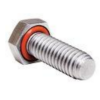
Use insulating washers, bushings, or sleeves: Insert non-metallic isolators between dissimilar metal contact surfaces, such as nylon washers, plastic sleeves, rubber gaskets, or insulated coated gaskets, to completely block direct metal-to-metal contact and the electron pathway. This is one of the most direct and effective methods.
-
Apply non-conductive coatings: Apply complete organic coatings (such as epoxy, polyester, or Dacromet) to the surfaces of fasteners and/or connected components to provide a physical barrier. Ensure the coating is not damaged during installation, as any breach can become a breakthrough point for corrosion.
-
Utilize Protective Coatings and Treatments:
-
Sacrificial anode coatings: Plate a more electronegative metal onto the more electropositive fastener, such as galvanizing steel fasteners. The zinc layer acts as a sacrificial anode, corroding preferentially to protect the steel substrate. Even if the coating has minor damage, it can still provide cathodic protection.
-
Inert barrier coatings: For fasteners like stainless steel and titanium alloys, passivation treatment can enhance the stability of the surface oxide film. For all metals, applying heavy-duty anti-corrosion coatings such as Dacromet, Geomet, or powder coating can significantly extend their corrosion-resistant lifespan.
-
Coating integrity: Ensure that the threaded portions of fasteners also have appropriate coating protection, but pay attention to the impact of coating thickness on thread fit and torque coefficients.
-
Control the Environment and Add Inhibitors:
-
Sealing and drying: Where possible, seal the connection areas (e.g., using sealants) to prevent electrolyte intrusion. Keep the interior of the equipment dry.
-
Use corrosion inhibitors: In closed systems (such as cooling water systems or fuel tanks), add volatile or contact-type corrosion inhibitors that form a protective film on the metal surface.
-
Strengthen Maintenance and Monitoring:
-
Regular inspections: Establish a regular inspection system for areas prone to galvanic corrosion, focusing on dissimilar metal joints, crevices, and coating breaches.
-
Timely repairs: When signs of corrosion are found, promptly clean the corrosion products and reapply insulation or coating protection.
-
Cathodic protection: For large fixed structures (such as ship hulls, underground pipelines, and offshore platforms), apply impressed current cathodic protection or install sacrificial anode blocks for systematic protection.
Conclusion
Galvanic corrosion of fasteners is a predictable and preventable systematic issue. It requires engineers and users to go beyond focusing on the performance of individual fasteners and comprehensively consider the entire connection system from the perspectives of materials science, electrochemistry, and environmental interactions. Shenzhen Toprecision Technology Co., Ltd. recommends integrating galvanic corrosion risk assessments into specifications during the early stages of project design. By employing scientific material pairing, rational insulation design, long-lasting surface protection, and standardized installation and maintenance, a multi-level defense system can be established. Only in this way can the breeding of galvanic corrosion be fundamentally curbed, ensuring the long-term safety and stability of fastened connections in complex and harsh environments, extending the overall service life of equipment, and reducing life-cycle maintenance costs.





















 Login
Login








 Contact
 WeChat
 粤ICP备2025493240号-1