























One-stop Fastener
Custom Manufacturing Expert

Toprecision Precision Blog

Latest technical articles and product updates of Toprecision Precision, providing professional fastener knowledge and application solutions.

Toprecision Precision Blog

Latest technical articles and product updates of Toprecision Precision, providing professional fastener knowledge and application solutions.

Blog Details

Principles and Classifications of Expansion Bolts

Download the full PDF version of this article: /uploads/soft/260625/3-260625160324.pdf >
This article explains how expansion bolts anchor in hard substrates, analyzing how radial pressure creates friction and mechanical interlock.
Expansion bolts are common architectural fasteners primarily used to achieve reliable anchoring in hard substrates such as concrete and masonry. Their core working principle relies on their expansion structure to generate radial pressure within the drilled hole of the substrate, thereby creating immense frictional force or mechanical interlock to resist external tensile and shear forces. Understanding their principles and classifications is the foundation for correct selection and application.
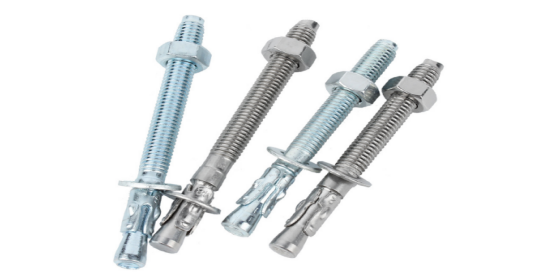
The working principle of expansion bolts is primarily based on the mechanical process of "expansion." During installation, the bolt is inserted into a pre-drilled hole, and tightening the nut causes the threaded rod to move upward. The upward movement of the rod forces the expansion sleeve at the bottom (usually composed of multiple segments) to expand radially outward, pressing tightly against the walls of the hole. This compression produces two key effects: first, immense static friction prevents the bolt from being pulled out; second, mechanical interlock is formed between the expansion segments and the irregular surface of the hole wall, further enhancing pull-out resistance. In certain designs, the expansion mechanism may also be achieved through the movement of a conical nut within a sleeve, operating on the same principle. Its anchoring force mainly depends on the strength of the substrate material, the precision of the installed hole, and the expansion force of the bolt.
Based on their expansion mechanisms and load-bearing characteristics, expansion bolts are mainly divided into two major categories: friction-type and bearing-type. Friction-type expansion bolts rely primarily on the friction between the expansion sleeve and the hole wall to bear loads. The typical representative is the sleeve-type expansion bolt, which features a relatively simple structure and convenient installation. It is suitable for scenarios bearing moderate tensile and shear forces and is the most common type in daily architectural installations. Bearing-type expansion bolts, on the other hand, focus more on mechanical interlocking. During expansion, the expansion segments not only generate friction but also embed or wedge into the substrate material, forming direct mechanical bearing. Bolts of this type, such as heavy-duty wedge expansion bolts, can provide higher tensile and shear load-bearing capacities. They are especially suitable for heavy-duty structural anchoring that bears vibrations and impact loads, or for applications with extremely high safety factor requirements.
Furthermore, based on construction methods, they can be divided into pre-embedded types and post-installed undercut types. Pre-embedded types are placed before concrete pouring and integrate with the structure, offering excellent anchoring force. Post-installed undercut types use specialized tools to create a conical cavity at the bottom of a straight hole. After inserting the bolt, expansion forms a "key-shaped" lock. This type features high load-bearing capacity and small edge distance advantages, belonging to high-end bearing-type products.
 

Need Customized Documents? Get Exclusive Precision Fastener Technical Solutions!

Consult Now

Need Customized Documents? Get Exclusive Fastener Technical Solutions!

Consult Now
WeChat

WeChat

Scan to add WeChat

Long press to scan

Service