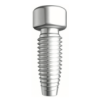
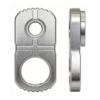
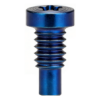
Aviation titanium fasteners see strong demand from global aviation recovery and China's industry rise.
Aviation manufacturing is often hailed as the "pearl in the crown of manufacturing." As the "critical links" connecting core components such as fuselages, engines, and landing gears, aviation titanium alloy fasteners hold a pivotal position in the aviation sector. Their unique advantages, including low density, high specific strength, corrosion resistance, and high-temperature tolerance, make them essential basic components for ensuring aviation equipment safety and enhancing flight performance. As ARJ21-700 chief designer Wu Guanghui noted, fasteners are "numerous, categorized, connecting structures, integrating systems, and turning small parts into great achievements." Their quality directly dictates the reliability and safety of aviation equipment.
Currently, the global aviation industry is in a critical phase of rapid recovery and upgrading. The continuous prosperity of the commercial aviation market, the iteration of military aviation equipment, and the accelerated expansion of general aviation have created a strong growth momentum for aviation titanium alloy fasteners, making it one of the most promising sub-sectors in the fastener industry.
Robust International Market Demand
With the global aviation industry's recovery, major manufacturers like Boeing and Airbus are increasing R&D for new aircraft. Titanium alloy fasteners are highly favored for their lightweight, high-strength, and corrosion-resistant properties. Since reducing an aircraft's weight by 10% saves 4% in fuel, the application ratio of titanium fasteners is continuously rising. For instance, replacing steel fasteners with titanium in the Boeing 747 reduced fuselage weight by 1,814 kg, while the Russian Tu-204 saved 688 kg using 940 kg of BT16 titanium fasteners. The peak replacement cycle for global commercial aircraft and the expansion of the aviation maintenance market further drive steady international market growth.
Explosive Domestic Market Growth
China's aviation industry is transitioning from "manufacturing" to "creation." The steady progress of the C919 domestic large aircraft project has brought tremendous opportunities. Each C919 requires approximately 200,000 titanium alloy fasteners. Domestic companies like Baoti Group and Dongfang Lantian Titanium Technology have successfully supplied materials and components, aiding the localization of core parts. Additionally, the batch deployment of advanced military aircraft (e.g., Y-20, J-20) and the expanding domestic maintenance market provide stable demand. Domestic enterprises have also broken foreign monopolies in key materials like TC4 and TC16 titanium alloy wires.
Despite rapid growth, the domestic industry faces challenges. High-end aerospace fasteners still heavily rely on imports, which are often 2-3 times more expensive than domestic products, posing supply chain risks. Furthermore, domestic enterprises still lag behind Western counterparts in high-end processing, precision testing, and brand influence. However, with increased R&D and policy support, the import substitution process is accelerating.
Strategic Guidelines for Enterprises and Investors
The aviation titanium alloy fastener market offers broad prospects. To navigate this landscape and achieve stable returns, we provide three core guidelines based on professional insights from the Baoji Titanium Industry Research Institute:
-
Strengthen Technical Investment: Aviation fasteners have high production thresholds involving cold/hot forging, heat treatment, and precision machining. Investors should focus on core R&D, invest in advanced equipment, and master key technologies like surface strengthening. Strict adherence to international testing standards (e.g., ASTM F606, NASM 1312) is crucial to ensure aviation-grade quality and break foreign monopolies.
-
Expand Markets and Build Brands: Facing fierce competition from international giants, domestic enterprises should target core sectors like commercial and military aviation. By establishing strict quality control systems, companies can ensure product reliability and build a premium domestic brand image. Leveraging China's aviation industry advantages to expand overseas is also recommended.
-
Monitor Policy Trends: As a high-end manufacturing sector, this industry is highly sensitive to national industrial and aviation development policies. Investors must closely track policy dynamics, adjust business strategies proactively, and capitalize on policy dividends supporting high-end equipment manufacturing and domestic large aircraft development.




























 Login
Login












 Contact
 WeChat
 粤ICP备2025493240号-1