XPeng and Huawei's clashing L4 strategies accelerate autonomous driving commercialization.
The debate over the technical roadmap for L4 autonomous driving is heating up, with XPeng aggressively pushing for mass production for the consumer market while Huawei and others advocate for a gradual approach. Beneath this accelerated industry rollout lies a surging demand for high-end precision fasteners, which has emerged as a core lever for fastener companies to break through and achieve growth.
The recent clash over autonomous driving technology routes has suddenly become the focal point of both the tech and automotive industries. Behind this dispute, a brand-new growth space is quietly opening up for the fastener industry. As a veteran in the field, I will dissect the core logic of the L4 route debate from an industry perspective, interpret its profound impact on the fastener sector, and help peers accurately capture hidden commercialization opportunities to seize the high-end market.
01 L4 Accelerates: Top Domestic and Global Players Make Dense Moves, Fastener Demand Leads the Way
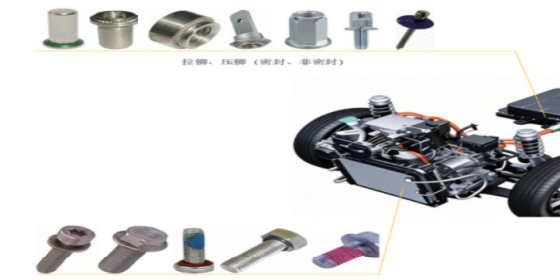
In April alone, leading domestic and international enterprises released intensive updates on L4 autonomous driving, continuously pushing technological implementation and commercialization. Every step forward relies on the support of precision fasteners. As the "connecting link" of autonomous driving systems, the stable operation of every core component—from cameras and radars in the perception layer, to chips and controllers in the decision-making layer, and wire-controlled chassis and steering systems in the execution layer—depends on high-quality fasteners for locking and fixing.
Baidu Apollo is continuously expanding its fully unmanned L4 commercial map. Its "Luobo Kuaipao" (Robotaxi) has been deployed in 26 cities at home and abroad, with cumulative orders exceeding 20 million. The acceleration of L4 technology migrating from Robotaxis to passenger cars means a simultaneous expansion in demand for in-car precision fasteners. The high-frequency operation of Robotaxis requires fasteners with higher fatigue and vibration resistance, while the passenger car scenario demands greater lightweight and miniaturization.
Changan Automobile has been approved for an L4 Robotaxi full-scenario test license in the Chongqing Yongchuan Intelligent Connected Pioneer Zone, adopting a dual-track strategy with L2/L3/L4 technological synergy. SAIC, FAW, Chery, and other automakers have also secured L4-related test licenses. This dense layout by leading automakers directly drives upstream supply chain demand, especially for precision locking and anti-loosening fasteners adapted for advanced intelligent driving.
Pony.ai, WeRide, and Tesla are also accelerating their layouts. Pony.ai is pushing global L4 Robotaxi deployment, planning to cover over 20 cities with a fleet of 3,000 vehicles by the end of 2026. Behind the goal of single-vehicle operational break-even is a rigorous test of fastener reliability. WeRide is expanding L4 technology to commercial vehicles like sanitation trucks, signing a 300-unit procurement order with Zhonghuanjie. The complex working conditions of commercial vehicles require fasteners with stronger corrosion and impact resistance. Tesla is accelerating the landing of FSD in China, gradually evolving toward L4 capabilities. Building its high-computing perception system requires a large number of customized precision fasteners for component integration.
02 Routes Diverge, Demand is Undisputed: L4 Landing Relies on High-End Fasteners
Beyond the divergence between XPeng and Huawei, industry opinions are polarized. NVIDIA CEO Jensen Huang stated that L4 is "just around the corner," while Valeo China CTO Gu Jianmin reminded the industry that we are still in the first half of the autonomous driving marathon, and L4 scale landing is not an overnight process. However, a consensus has formed: the landing of L4 cannot be achieved without the reliability of core components, and precision fasteners are the key to ensuring their stable operation.
The aggressive route of "skipping L3 and going straight to L4" seems like a technological breakthrough, but it actually imposes stricter requirements on fasteners. L4 requires the system to assume full driving responsibility, meaning zero margin for error from perception to execution. The installation of cameras and LiDAR requires high-precision fasteners to ensure accurate positioning and avoid perception deviations caused by vibration. Wire-controlled chassis and braking systems require high-strength anti-loosening fasteners to prevent component loosening during high-speed driving or emergency braking, ensuring driving safety.
Huawei's "gradual route" also relies on fastener upgrades. L3 technical validation is essentially a test of fastener adaptability, accumulating experience for L4 scale application. Gu Jianmin mentioned that in the next three to five years, L4 will explode first in restricted scenarios. Whether it is port heavy trucks, city sanitation vehicles, or restricted-area Robotaxis, these complex working conditions demand higher fastener performance. For example, port heavy trucks in high-temperature, high-dust environments require corrosion-resistant and wear-resistant fasteners, while sanitation vehicles operating at high frequencies require fatigue-resistant, long-life fasteners.
In fact, as early as 2017, international automakers like Volvo proposed prioritizing L4 and downplaying L3 commercialization, meaning the layout of high-end fasteners has long been a prerequisite for automakers to seize the L4 track. For fastener companies, as long as L4 continues to advance, the demand for high-end precision fasteners will continue to grow, representing an unmissable industry tailwind.
03 Commercialization Hits a Roadblock: How Can Fastener Companies Break Through and Convert?
Despite the strong momentum of L4 landing, the industry still faces four rigid bottlenecks, which are precisely the key entry points for fastener companies to break through and improve conversion rates. Academician Li Keqiang of the Chinese Academy of Engineering pointed out that L4 scale landing faces four major challenges: technological limitations, high costs of core components, lack of regulations, and fragmented scenarios. These four issues are all closely related to the fastener industry.
First, on the technological front, the long-tail extreme scenarios of L4 pose ultimate demands on fastener reliability. For example, the collective shutdown of Robotaxis in San Francisco and Wuhan was partly due to loose component connections. Under extreme weather and complex road conditions, ordinary fasteners are prone to fatigue and loosening, affecting system operation. This requires fastener companies to increase R&D investment and develop high-end products adapted for extreme scenarios, such as anti-loosening, anti-vibration, and high/low-temperature resistant precision fasteners, to solve core automaker pain points.
Second, on the cost front, the high cost of automotive-grade core components makes automakers eager to reduce supply chain costs. Fastener companies can achieve economies of scale and optimize processes to reduce the production costs of high-end precision fasteners while ensuring performance. Providing customized solutions to precisely match automaker needs and improve cost-performance will help companies become core suppliers.
Li Xiang, founder of Li Auto, emphasized that full-scenario L4 landing must start from restricted scenarios and advance gradually. This provides a clear market entry point for fastener companies. We can prioritize Robotaxis, port heavy trucks, and sanitation vehicles, developing targeted fastener products to accumulate industry experience and customer resources, and then gradually expand to the passenger car C-end market for steady conversion.
Furthermore, the process of regulatory refinement is also a process of standard upgrading for the fastener industry. As L4 regulations become clearer, standard requirements for fasteners will become stricter. We need to benchmark against international automotive-grade standards in advance, improve quality control systems, and create high-end fastener products that meet automotive-grade requirements to seize market first-mover advantages.
As a senior practitioner in the fastener industry, I firmly believe that every technological revolution is an opportunity for industry reshuffling and upgrading. The intensifying L4 route debate appears to be a game between the automotive and tech industries, but it actually opens up high-end, large-scale growth space for the fastener industry. Currently, with leading automakers densely deploying L4, the demand for high-end precision fasteners is already evident. For fastener companies, only by closely following industry trends, focusing on L4 scenario needs, increasing R&D investment, optimizing product structures, and improving service quality can we seize this tailwind to achieve a dual boost in conversion rates and brand influence.





















 Login
Login











 Contact
 WeChat
 粤ICP备2025493240号-1