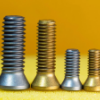
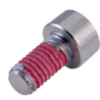
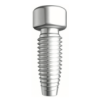
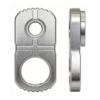
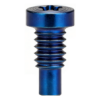
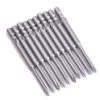
In the fields of mobile phone manufacturing and fastener procurement, stainless steel has long been the default material for CD-pattern screws. This established industry standard is widely recognized by procurement personnel, yet it is not a random choice. Instead, it represents a perfect match among material properties, processing technology and end-product requirements. Many buyers have questioned why carbon steel (high strength), titanium alloy (excellent comprehensive performance), and aluminum alloy (outstanding lightweight advantages) cannot replace stainless steel as the preferred material for mobile phone CD-pattern screws. The answer lies in the unique functional and aesthetic requirements of CD-pattern fasteners and their strict material selection criteria.
It is critical to distinguish CD-pattern screws from ordinary fasteners. Beyond serving as simple structural connecting parts, CD-pattern screws undertake an important decorative role in mobile phone appearance design. The CD pattern consists of dense, uniform circular grooves precisely etched by laser equipment. These micro-grooves produce layered metallic light reflection under illumination, creating an optical disc-like texture — hence the name “CD pattern”. This specialized decorative effect demands far higher surface quality and processing stability than standard screws, among which material plasticity serves as the core determinant of successful CD pattern forming.
CD laser etching requires materials with moderate plasticity, which directly governs pattern clarity, structural integrity and surface gloss. Plasticity refers to a material’s ability to deform under external force without cracking. Materials with insufficient plasticity are highly brittle and tend to develop micro-cracks during laser etching. These tiny fractures break pattern continuity, reduce surface luster, and may expand under alternating stress during service, ultimately causing screw fracture. On the contrary, materials with excessive plasticity result in severe tool adhesion. Laser etching debris adheres to the workpiece surface, failing to form clean and neat grooves, scratching the surface and ruining the decorative texture.
Stainless steel becomes the optimal solution precisely because of its naturally balanced moderate plasticity, which can be further optimized through vacuum heat treatment. Common austenitic stainless steels such as 304 and 316 feature ideal plasticity under annealed conditions, enabling stable laser etching of uniform, smooth and highly reflective CD patterns. Vacuum heat treatment realizes an excellent balance between strength and plasticity, eliminating processing deformation and micro-cracks while meeting the mechanical strength requirements of precision mobile phone assembly. Furthermore, stainless steel delivers superior corrosion resistance. Mobile phones are constantly exposed to sweat, moisture and other corrosive substances during daily use. Stainless steel effectively resists oxidation and rust, preserving both the aesthetic consistency of CD patterns and long-term connection reliability — a comprehensive advantage unmatched by other materials.
Although carbon steel possesses high tensile strength, it shows fatal defects in CD pattern processing and consumer electronic application scenarios. Carbon steel plasticity varies drastically with carbon content: low-carbon steel features excessive plasticity that causes serious tool adhesion, while high-carbon steel is overly brittle and prone to cracking during precision etching. Neither is suitable for fine CD pattern fabrication. More importantly, carbon steel suffers from poor corrosion resistance. Even after galvanizing treatment, carbon steel screws easily rust in the enclosed, humid internal environment of mobile phones. Rust fades the decorative CD texture, and corroded particles may interfere with internal circuit operation, posing potential safety risks. Despite its cost benefits, carbon steel cannot be adopted for mobile phone CD-pattern screws due to inherent performance limitations.
Aluminum alloy and titanium alloy are also eliminated due to their respective material constraints. Aluminum alloy has extremely high plasticity, leading to severe adhesion during laser etching, which makes clear CD patterns unachievable. In addition, its low mechanical strength is further weakened after surface grooving, failing to sustain assembly preload and structural stability of precision mobile phone components. Titanium alloy meets the requirements for plasticity and corrosion resistance, yet it faces practical application barriers. Its low thermal conductivity causes extreme heat concentration during laser processing, resulting in localized material property degradation. Meanwhile, titanium alloy costs several times more than stainless steel, making it economically unviable for mass-produced consumer electronic products such as smartphones.
Vacuum heat treatment plays an indispensable role in optimizing stainless steel performance for CD-pattern screws. Conducted in an oxygen-free environment, this heating, holding and cooling process eliminates surface oxidation and decarbonization commonly seen in traditional heat treatment, ensuring uniform and consistent surface gloss after laser etching. Accurate thermal parameter control increases the yield strength of stainless steel by over 20%. While retaining the moderate plasticity required for decorative processing, the technology greatly enhances structural stability and connection safety, perfectly satisfying mobile phones’ dual demands for exquisite appearance and reliable mechanical performance.
For procurement and manufacturing personnel, selecting stainless steel CD-pattern screws means guaranteed processing stability and long-term service reliability. Stainless steel enables consistent mass production of high-precision decorative patterns, maintains stable performance in complex daily usage environments, and delivers reasonable cost efficiency suitable for large-scale smartphone manufacturing. Fundamentally, stainless steel is not superior in any single performance indicator, but it provides the most balanced overall solution that perfectly coordinates material characteristics, processing feasibility, cost control and product application requirements — explaining why it has become the industry-standard material for mobile phone CD-pattern screws.





















 Login
Login








 Contact
 WeChat
 粤ICP备2025493240号-1