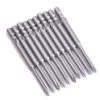
In the fastener industry, surface treatment serves as a core procedure that determines product performance and market competitiveness. Industry data shows that approximately 90% of carbon steel fasteners worldwide undergo electroplating, coating and other surface treatment processes. Their core purposes include not only improving corrosion resistance and surface aesthetics, but also optimizing wear resistance and precisely controlling key performance parameters such as the torque-tension K-factor. As global leaders in fastener technology and standard formulation, European and American manufacturers follow a clear development logic for surface treatment — driving technological innovation through standard iteration and upgrading processes to match refined application requirements — which provides valuable references for the entire industry.
The iteration of surface treatment processes in Europe and America has always been driven primarily by standard updates. This standard-first philosophy has become increasingly prominent in recent revisions of international specifications. The year 2011 marked a critical turning point, as legacy surface treatment standards could no longer meet the stringent environmental and high-performance requirements of advanced equipment. Authoritative institutions including ISO/TC2/SC14 (ISO Fastener Surface Coatings Subcommittee) and ASTM F16.03 (ASTM Fastener Coatings Subcommittee) accelerated the revision of core specifications. A new set of standards covering electroplating, zinc flake coating and hot-dip galvanizing was intensively released between 2014 and 2015, with some standards completely restructured.
The revisions of the new standards precisely respond to upgraded market demands. In European and American industrial practices, customer requirements have evolved from basic anti-corrosion and decorative needs to composite demands centered on environmental compliance, high performance and operational safety. High-end sectors such as automotive and wind power explicitly mandate chromium-free passivation for environmental protection, while quantifying technical indicators including hydrogen embrittlement resistance of high-strength fasteners and the matching consistency between coating systems and assembly torque-tension performance. Vague quality specifications in old standards have been fully refined. Taking the updated ASTM hot-dip galvanizing standard as an example, it clearly defines coating thickness ranges for different service conditions, adds non-destructive testing methods for coating uniformity, and incorporates hydrogen embrittlement risk assessment into mandatory inspection procedures.
Guided by the upgraded standards, European and American fastener enterprises do not merely comply with specifications passively. Instead, they deeply integrate standard requirements into R&D and production, forming a closed-loop management system of standards, technology and quality. This systematic thinking has enabled them to achieve remarkable advantages in the upgrading of the three mainstream surface treatment processes.
The upgrading of electroplating processes focuses on dual improvements in environmental protection and safety. To eliminate pollution caused by hexavalent chromium passivation in traditional processes, European and American manufacturers took the lead in promoting chromium-free passivation technology. By developing zirconium-based and titanium-based passivation solutions, zero pollutant emission is realized without compromising corrosion resistance. More importantly, targeting the hydrogen embrittlement bottleneck of high-strength fasteners, a full-process hydrogen control system covering pretreatment, electroplating and post-treatment has been established. Ultrasonic degreasing replaces traditional acid pickling to reduce hydrogen adsorption; current density and temperature are precisely controlled during electroplating to avoid hydrogen embrittlement inducements; a low-temperature baking process at 200°C is added for post-treatment hydrogen removal, reducing the hydrogen embrittlement rate by more than 80%. Data from a German manufacturer shows that this upgraded process extends the service life of high-strength bolts in wind power equipment from 5 years to 15 years.
Zinc flake coating technology (also known as Dacromet) achieves breakthroughs toward high-performance composite systems. Widely adopted for outdoor fasteners due to excellent corrosion resistance, traditional zinc flake coatings suffer from insufficient impact resistance. European and American manufacturers enhance coating hardness by adding nano-alumina particles. Meanwhile, they develop a composite system of zinc flake base coat + topcoat + sealant. This innovation increases the salt spray test durability from 500 hours to 1000 hours. In addition, the lubricating ingredients contained in the topcoat stabilize the torque-tension K-factor fluctuation within ±5%, perfectly adapting to high-precision assembly scenarios such as automotive chassis systems.
The upgrading of hot-dip galvanizing focuses on precise control and efficiency optimization. To solve the problems of uneven coating thickness and high energy consumption in traditional processes, European and American manufacturers adopt induction heating preheating technology, which automatically adjusts preheating temperature and duration according to fastener specifications, controlling coating thickness deviation within ±10μm. Furthermore, alloyed zinc solution technology with trace aluminum and nickel elements significantly improves bonding strength between the coating and substrate, preventing coating peeling during transportation and assembly. After adopting these technologies, a leading American fastener manufacturer reduced the rework rate of hot-dip galvanized products from 12% to 2% and improved production efficiency by 30%.
European and American industrial practices reveal a core development logic: process upgrading is never a single technical breakthrough, but in-depth collaboration with upstream and downstream industrial demands. For the aerospace sector, manufacturers jointly develop customized coating solutions with OEMs. The coating system is precisely designed according to installation positions and stress conditions of fasteners. Ceramic-based composite coatings are applied to fasteners in high-temperature engine areas to enhance heat resistance, while zinc-aluminum coatings are adopted for lightweight fuselage components to balance weight reduction and corrosion resistance. This demand-driven R&D model enables surface treatment technology to fundamentally improve the overall performance of high-end equipment.
For domestic fastener enterprises in China, the development path of European and American brands provides a clear benchmark for upgrading. First, enterprises must strengthen standard sensitivity, proactively track revisions of ISO and ASTM international standards, and translate standard requirements into internal process specifications. Second, focus on the two core development directions of environmental compliance and high performance, and increase R&D investment in chromium-free passivation and low-hydrogen-embrittlement processes. Third, strengthen collaborative R&D with downstream high-end equipment manufacturers to transform the passive "drawing-based processing" model into active demand-oriented innovation.
From standard iteration and technical implementation to systematic process optimization and customized solution output, European and American manufacturers have set a benchmark for global fastener surface treatment. Against the backdrop of high-end and green transformation in the global manufacturing industry, Chinese enterprises can achieve competitive breakthroughs in surface treatment technology only by taking standards as the guideline, technology as the core, and market demand as the orientation.
















 Login
Login








 Contact
 WeChat
 粤ICP备2025493240号-1