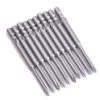
Featuring high strength (tensile strength ≥ 1000MPa) and superior toughness, Grade 10.9 high-strength bolts are widely applied in critical load-bearing scenarios such as wind power equipment, heavy industry machinery and steel structure engineering. As the core force-transmitting part, the bolt head, once fractured, may trigger severe safety accidents including equipment shutdown and structural collapse. Industry failure statistics show that head fractures account for more than 60% of all failure cases of Grade 10.9 high-strength bolts. An in-depth analysis of fracture causes and the formulation of targeted prevention and control measures are of great practical significance for ensuring engineering safety.
Material defects are the fundamental inducement of bolt head fractures, mainly reflected in unbalanced chemical composition and internal structural flaws. The performance of Grade 10.9 bolts relies on strict control of core alloy elements including carbon, manganese and chromium. The carbon content must be maintained between 0.22% and 0.29%. Excessively high carbon content increases material brittleness and easily causes hidden cracks during head cold heading, while insufficient carbon fails to meet strength requirements after heat treatment. To reduce costs, some small and medium-sized manufacturers improperly reduce the addition of manganese and chromium, resulting in insufficient hardenability and soft spots on bolt heads, which further cause fracture under load due to uneven strength distribution. Internal structural defects are more concealed. Oxide and sulfide inclusions that are not completely removed during smelting form micro-crack sources on bolt heads. These cracks gradually expand under alternating loads and eventually lead to sudden fractures. Testing of failed bolts from a wind power project shows that over 80% of fractured parts contain excessive sulfide inclusions.
Improper processing techniques serve as a key contributing factor to head fractures, with inadequate control in cold heading and heat treatment being the most prominent issues. Cold heading is the core process for bolt head forming. If the die fillet radius is too small (less than 1.5 times the thread pitch), severe stress concentration will occur at the transition zone between the bolt head and shank. Excessively fast cold heading speed (over 50 strokes per minute) leads to inadequate plastic deformation and work hardening. More critically, some manufacturers omit the spheroidizing annealing process before cold heading to improve efficiency, resulting in higher material hardness, reduced plasticity and direct crack generation during head forming. Uneven quenching during heat treatment is also fatal. Unregulated cooling speed of quenching media creates a temperature difference of over 200℃ between the surface and core of the bolt head, producing residual tensile stress. In addition, tempering temperatures below 550℃ fail to release internal stress effectively. Such residual stress superimposes with external load after installation and induces delayed fracture.
Non-standard installation operations are the direct trigger of fractures, mainly manifested in unbalanced preload control and eccentric installation. According to material mechanics principles, the preload of Grade 10.9 bolts should be controlled within 70%–80% of the yield strength. Excessively high preload keeps the bolt head under long-term plastic deformation, while insufficient preload causes bolt loosening and impact load. In actual construction, some workers fasten bolts by experience and hammering instead of calibrated torque wrenches, resulting in preload exceeding the standard value by more than 30%. Furthermore, residual impurities between the bolt head and washer cause eccentric preload, subjecting the bolt head to additional bending moment and increasing the stress concentration factor by 2 to 3 times. Inspection of steel structure bridges indicates that 30% of fractured bolt heads have obvious eccentric indentations, directly proving non-standard installation behaviors.
Harsh operating conditions accelerate the fracture process, dominated by the synergistic effect of corrosion and alternating loads. Acid and alkaline media in industrial scenarios cause electrochemical corrosion on bolt heads, forming corrosion pits deeper than 0.1mm. These pits become stress concentration points and reduce fatigue strength by over 40%. In fields such as wind power and metallurgy, bolts bear high-frequency alternating loads. When the stress cycle exceeds 10⁶ times, micro-cracks at corrosion pits expand rapidly. Moreover, high-temperature environments (above 200℃) induce stress relaxation of bolt heads, reducing material strength by 15%–20% and leading to creep fracture under continuous load.
A full-life-cycle prevention and control system must be established to address the above causes. In terms of material quality control, spectral analysis shall be adopted to detect chemical composition, and ultrasonic testing shall be conducted to eliminate internal inclusions. For processing management, cold heading die fillets must comply with GB/T 3098.1 standards, and mechanical properties must be verified via hardness testers and metallographic microscopes after heat treatment. During installation, only calibrated torque wrenches are permitted, ensuring the preload deviation is controlled within ±5%. For environmental protection, Dacrom coating is applied for corrosion-prone working conditions, and lock washers are added for scenarios with alternating loads.
In conclusion, head fractures of Grade 10.9 high-strength bolts result from the superposition of multiple problems in material, processing, installation and service conditions, rather than a single factor. Manufacturers should abandon the misconception of prioritizing production output over quality control and implement full-process quality management. For fastener practitioners, mastering fracture mechanisms and prevention measures not only enhances product competitiveness but also undertakes the essential responsibility of safeguarding engineering safety.

















 Login
Login








 Contact
 WeChat
 粤ICP备2025493240号-1