















 Login
Login






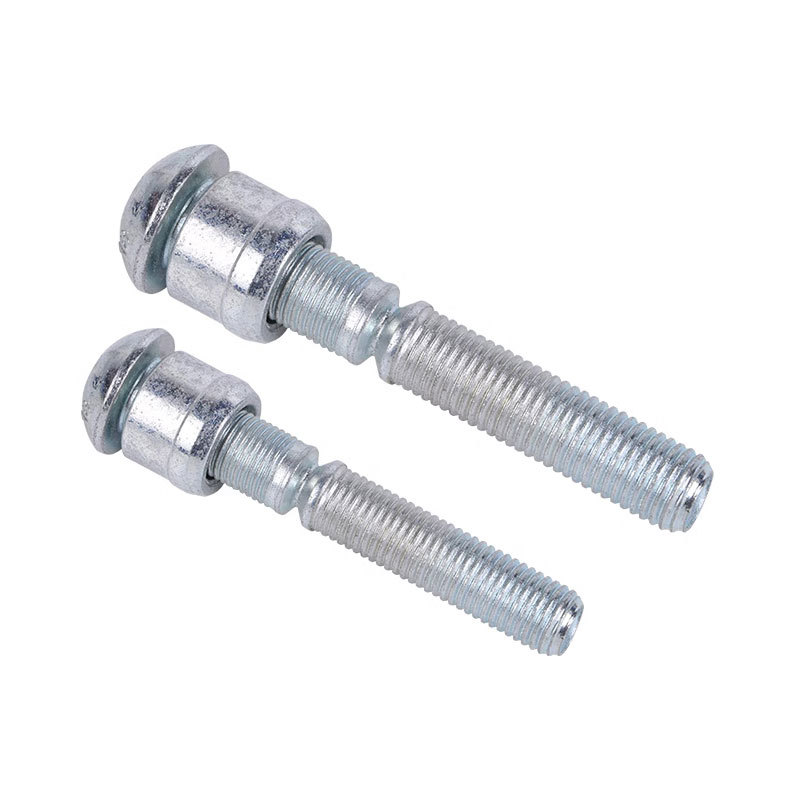
Threaded connections, due to their advantages of "easy assembly, flexible disassembly, and strong adaptability," have become the most mainstream fastening method in mechanical structures — from fixing household appliance panels to connecting wind power flanges, the tightening reliability of a single bolt directly determines equipment operational safety. However, in practice, failures caused by bolt loosening are common. Loose automotive chassis bolts can lead to steering deviation. Loose wind turbine blade connection bolts cause equipment noise and even blade instability. In more severe cases, loose bolts in building steel structures can lead to collapse. The essence of bolt loosening is that during service, factors such as alternating loads and vibration impact cause the clamping force to deviate from its initial value and continuously decay. When the clamping force falls below a critical value, the connection fails. Among anti-loosening technologies, friction anti-loosening accounts for more than 70% of applications due to its core advantages of "removability and ease of operation." Surface treatment, as a key means of regulating friction coefficient and enhancing anti-loosening performance, has its importance often overlooked. This article uses transverse vibration test data to deeply analyze the influence of different surface treatment processes on bolt anti-loosening performance, revealing the intrinsic relationship between surface treatment and anti-loosening effectiveness.
To understand the anti-loosening role of surface treatment, one must first clarify the self-locking mechanism and loosening mechanism of threaded connections. The natural self-locking of threaded connections stems from the balance between the thread helix angle and the friction angle. When the thread helix angle is smaller than the friction angle of the contact surfaces, the bolt can remain tight under static loads even without additional anti-loosening measures. However, under dynamic conditions, vibration causes the workpieces to separate slightly, periodically reducing the normal pressure between thread pairs and consequently reducing the friction angle. Impact loads may instantaneously break the self-locking balance, creating a tendency for the threads to slip. In this context, the coating or film formed by surface treatment becomes the "core defense line" for maintaining friction coefficient stability and resisting loosening. By changing the physical morphology and chemical characteristics of the thread surface, surface treatment regulates the magnitude and stability of the friction coefficient, thereby improving anti-loosening performance.
Anti-loosening technologies are divided into two major categories: removable and non-removable. Mechanical anti-loosening (e.g., cotter pins, tab washers) and friction anti-loosening (e.g., surface treatment, double nuts) fall under removable anti-loosening. Among these, friction anti-loosening is the preferred choice for general scenarios because it requires no additional mechanical structures and is easy to operate. Non-removable anti-loosening (e.g., welding, staking) offers excellent anti-loosening effects but damages the thread structure, preventing bolt reuse, and is only suitable for permanent connections. The core logic of friction anti-loosening is to increase friction on thread contact surfaces and bearing surfaces to resist the relative rotation tendency caused by vibration. Surface treatment achieves this by precisely regulating the friction coefficient, and the choice of process directly determines the anti-loosening effectiveness.
To quantitatively analyze the influence of surface treatment, the industry commonly uses transverse vibration testing (in accordance with GB/T 10431-2008) to evaluate anti-loosening performance. The assembled bolted connection is placed on a vibration test bench, subjected to transverse vibration at a fixed amplitude and frequency, and the clamping force decay curve is monitored in real time. The "clamping force retention rate" is used as the core evaluation indicator — the higher the retention rate, the better the anti-loosening performance. Based on test data, the anti-loosening effectiveness of mainstream surface treatment processes shows significant differences, which can be divided into three categories.
The first category is basic protection processes, such as black oxide and phosphating, offering moderate anti-loosening performance, suitable for indoor static or light-vibration scenarios. Black oxide forms a black oxide film 0.5-1.5 μm thick on the bolt surface, maintaining surface roughness Ra at 1.6-3.2 μm, with a stable friction coefficient of 0.15-0.25. Transverse vibration tests show that for an M12 bolt with black oxide treatment, the clamping force retention rate after 100,000 vibrations is about 45%, which is better than untreated bolts (20% retention rate), but still prone to loosening under high-frequency vibration. Phosphating forms a porous zinc phosphate film that can retain a small amount of lubricating grease, making the friction coefficient more stable. Under the same test conditions, the clamping force retention rate increases to 55%, suitable for light-vibration applications such as motor end covers. The advantages of these processes are low cost and high efficiency, but the film is thin, corrosion resistance is limited, and anti-loosening performance is significantly affected by environmental humidity.
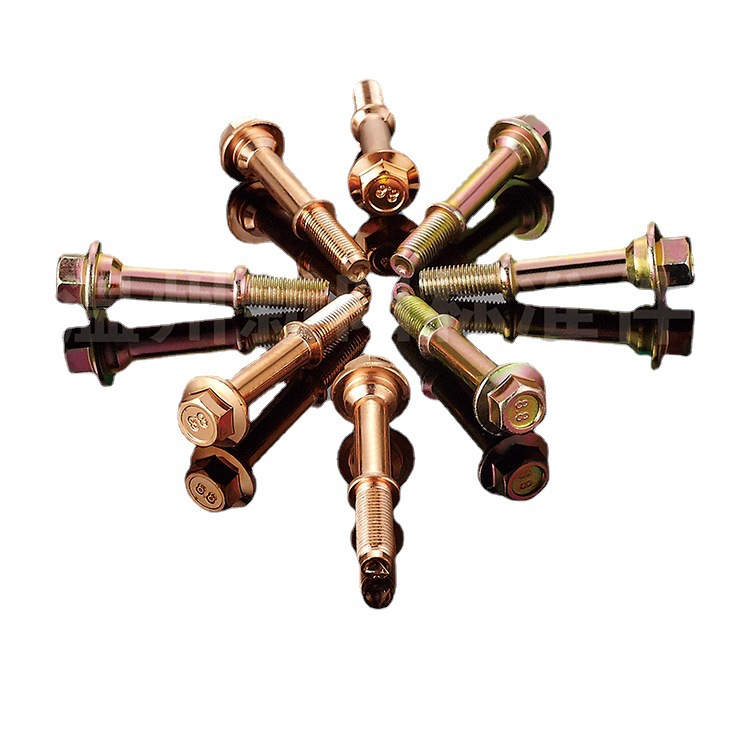
The second category is mid-to-high-end protection processes, such as zinc plating (with passivation) and nickel plating, offering balanced anti-loosening and corrosion resistance, suitable for outdoor or medium-vibration scenarios. Zinc plating forms a zinc coating 5-20 μm thick, combined with different passivation treatments to optimize performance. With color chromate passivation (Zn·C2C), the surface forms a honeycomb-like film, increasing the friction coefficient to 0.25-0.35, with a clamping force retention rate of 65% after 100,000 vibrations. With olive drab passivation (Zn·C2D), the film is thicker, providing higher friction coefficient stability, with a retention rate of 75%, suitable for construction machinery chassis bolts. Nickel plating forms a nickel coating with high hardness (above HV300), a smooth and uniform surface, and a stable friction coefficient of 0.2-0.3. Under high-low temperature cycling conditions, the clamping force retention rate after 100,000 vibrations remains 70%, suitable for temperature-fluctuation scenarios such as automotive transmissions. These processes achieve dual improvements in anti-loosening and corrosion resistance through optimization of coating thickness and passivation methods, and are currently the most widely used mid-to-high-end solutions.
The third category is high-end enhanced processes, such as Dacromet and sherardizing, offering excellent anti-loosening performance, suitable for extreme vibration or highly corrosive scenarios. Dacromet applies a zinc-aluminum-chromate coating (thickness 5-10 μm), forming a layered structure. The friction coefficient can be precisely adjusted to 0.3-0.4, and the film has good toughness, adapting to minor deformations of the bolt during vibration. Transverse vibration tests show that for an M12 bolt with Dacromet treatment, the clamping force retention rate after 200,000 vibrations remains above 80%, far exceeding other processes. At the same time, its salt spray corrosion resistance exceeds 1000 hours, making it the preferred choice for extreme scenarios such as offshore platforms and wind power flanges. Sherardizing forms an alloy layer through zinc atom diffusion, providing extremely strong bonding with the substrate and a stable friction coefficient. Under the same test conditions, the retention rate is 78%, suitable for high-temperature conditions such as boiler equipment bolts. Although these processes have higher costs (2-3 times that of zinc plating), their significant anti-loosening performance advantages make them indispensable in critical scenarios.
The core mechanisms by which surface treatment affects anti-loosening performance can be summarized in three points. First, surface roughness regulation — the film changes the microscopic morphology of the thread surface, increasing friction resistance. Second, friction coefficient stability — high-quality coatings or films maintain a stable friction coefficient during vibration, avoiding friction decay due to wear. Third, film toughness and adhesion — tough films buffer vibration impacts, and strong adhesion prevents film detachment and failure. Therefore, process selection must follow the principle of "working condition adaptation." For indoor light loads, choose black oxide or phosphating. For outdoor medium loads, choose zinc plating (olive drab passivation). For extreme conditions, choose Dacromet or sherardizing.
In summary, surface treatment is by no means merely a "decorative outer layer" for bolts but rather a "core variable" in friction anti-loosening. The reason others' bolts remain tightly fastened for long periods under complex working conditions is precisely because they have precisely matched the surface treatment process. For fastener practitioners, mastering the anti-loosening characteristics of different surface treatment processes and scientifically selecting based on working condition parameters such as vibration intensity and environmental corrosion is the only way to achieve "long-lasting tightness" in bolted connections, building a solid defense for equipment operational safety.



 粤ICP备2025493240号-1