


















 Login
Login






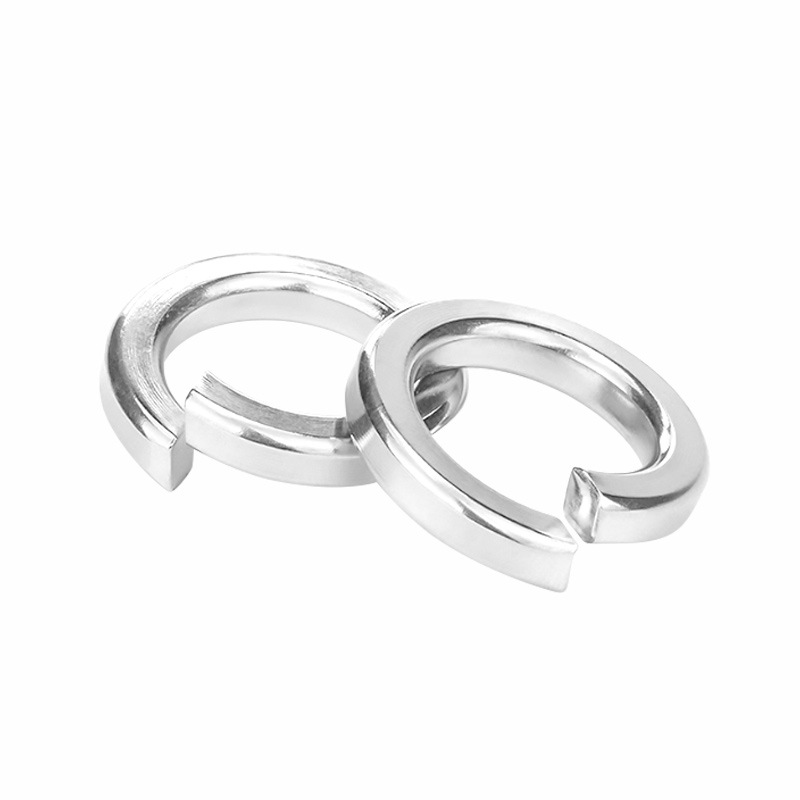
In mechanical joining systems, the spring washer (also referred to as a "spring washer" or "lock washer"), as a low-cost, simple-structure basic anti-loosening component, is widely used in fields such as electric motors, automotive, wind power, and home appliances. Industry statistics show that about 30% of thread connection loosening failures can be effectively avoided through the proper selection of spring washers. Their core value lies in solving the problem of preload decay in fasteners under vibration, impact, or temperature fluctuation conditions — by generating continuous axial pressure through their own elastic deformation, maintaining normal pressure and friction between thread pairs, while also providing some impact load buffering capacity. Deeply understanding the structural characteristics, stress mechanisms, and application points of spring washers is key for fastener professionals to ensure connection reliability.
The anti-loosening function of spring washers originates from their unique structural design. The most common ordinary split spring washer has an "Ω"-shaped ring shape with an axial split on the circumference. The ring cross-section is mostly rectangular or trapezoidal, and the outer diameter is slightly larger than the inner diameter. This structure gives it bidirectional elasticity: when subjected to axial pressure, the ring can flatten and deform to store elastic potential energy; when external pressure weakens or the thread shows a tendency to loosen, the elastic potential energy is released, pushing the bolt and nut back to maintain preload. More importantly, the split design causes the spring washer to generate a slight radial expansion force after installation, forming contact friction with the bolt shank wall, further enhancing the anti-loosening effect. Some spring washers used in special applications have optimized structures, such as toothed spring washers with a "stop claw" added at the split end, where the claw embeds into the surface of the workpiece to form mechanical locking, suitable for high-frequency vibration conditions.
The installation and stress process of the spring washer is the core link in realizing its anti-loosening function, requiring precise analysis combined with the force transmission path of thread tightening. Taking the typical combination of "bolt-spring washer-flat washer-workpiece" as an example, the entire stress process can be divided into three stages. The first stage is the initial tightening period. When the wrench applies torque to rotate the bolt, the bearing surface under the bolt head first compresses point A of the spring washer in the tightening direction (usually clockwise). At the same time, the flat washer, under the nut pressure, compresses point D of the spring washer clockwise. Points B (near the bolt side) and C (near the flat washer side) on both sides of the spring washer split begin to generate elastic bending deformation. At this time, the reaction force of the spring washer on the bolt and flat washer increases linearly with deformation. The second stage is the flattening and stabilization period. As torque continues to increase, the "Ω" shape of the spring washer gradually flattens. When points A and C, and points B and D are completely in the same plane, the spring washer reaches the "flattened state." At this point, its elastic deformation reaches its limit, and the generated axial pressure reaches its maximum value. This pressure directly converts into normal pressure between the thread pairs, making friction reach its peak. The third stage is the anti-loosening maintenance period. After tightening is completed, the external torque is removed, but the elastic recovery tendency of the spring washer continues to exert sustained axial force on the bolt and flat washer. Even if vibration in the working condition causes a slight loosening tendency in the thread, the elastic force of the spring washer instantly compensates, maintaining stable friction, thereby achieving anti-loosening.
Different types of spring washers are optimized for specific working conditions, with significant differences in their stress characteristics and applicable scenarios. Besides the ordinary split spring washer, commonly used types in the industry include: wave spring washers, which have a multi-wave annular structure, offering a larger range of elastic deformation and more uniform axial pressure. They are suitable for thin-walled workpieces or scenarios requiring frequent disassembly, avoiding indentation damage to the substrate caused by ordinary spring washers. Belleville spring washers, with a conical cross-section, have the characteristic of "small deformation, large elastic force." Their axial stiffness is much higher than ordinary spring washers, suitable for high-pressure sealing or heavy-load conditions, such as flange connections in hydraulic equipment. Curved spring washers have a symmetrical structure and excellent elastic recovery, with stable performance in low-temperature or corrosive environments, commonly used in outdoor power equipment connections. Additionally, there are combined spring washers, such as the "spring and flat washer combination" that integrates a spring washer and a flat washer, simplifying the assembly process, improving installation efficiency, and suitable for automated production lines.
The application effect of spring washers depends not only on the type selection but also on the match with working conditions and installation specifications. In the automotive industry, bracket bolts in engine compartments, subject to continuous vibration and high temperatures, require spring washers made of 65Mn material with heat resistance above 150°C. During installation, a torque wrench must be used to control preload torque — if the torque is too low, the spring washer is not fully flattened, resulting in insufficient elasticity; if the torque is too high, it can cause plastic deformation and failure of the spring washer. In hub connections for wind power equipment, due to large load fluctuations, a combined solution of "spring washer plus lock nut" is often used. The spring washer buffers high-frequency micro-vibrations, while the lock nut addresses low-frequency large impacts, providing double protection. In lightweight plastic part connections in the home appliance industry, thin wave spring washers are often chosen to avoid the high pressure of ordinary spring washers causing cracking of the plastic substrate.
Failure issues of spring washers require special attention. Common failure modes include elastic fatigue fracture, plastic deformation failure, and corrosion failure. Elastic fatigue fracture is often due to insufficient toughness of the spring washer material or the vibration frequency exceeding the tolerable range. For example, using an ordinary Q235 spring washer on a motor end cover subject to high-frequency vibration may fracture within 3,000 operating hours. Plastic deformation failure is mostly caused by over-tightening. When the torque exceeds the yield limit of the spring washer, it cannot recover its elasticity after flattening, losing its anti-loosening ability. Corrosion failure is common in outdoor or humid environments. Spring washers without anti-corrosion treatment rust easily, and rust can destroy the uniformity of elastic deformation. Countermeasures against these problems include: selecting matching materials (e.g., 50CrVA material for high-strength conditions, galvanized or Dacromet-treated spring washers for corrosive environments), strictly controlling tightening torque (recommended to establish torque standards based on spring washer specifications, e.g., M10 spring washer with torque of 8-10 N·m), and conducting regular non-destructive testing (e.g., using ultrasound to detect internal fatigue cracks in spring washers).
The selection of spring washers should follow the principle of "matching working conditions," which can be broken down into three steps. First, clarify the core requirements of the working condition: for high-frequency scenarios with vibration frequency >10 Hz, prioritize toothed spring washers or combined spring washers; for thin-walled or plastic parts, prioritize wave spring washers. Second, match material and surface treatment: for high-temperature conditions, choose heat-resistant alloy materials; for humid environments, choose products with anti-corrosion coatings. Finally, verify installation compatibility: ensure the gap between the inner diameter of the spring washer and the bolt shank diameter is ≤0.2 mm to avoid uneven stress due to misalignment during installation. Additionally, it is important to note that spring washers are not a universal anti-loosening solution. For ultra-high-speed rotation (e.g., spindle speed >10,000 r/min) or extremely low temperatures (< -40°C), it is recommended to combine adhesive locking or mechanical locking structures to enhance connection reliability.
As the machinery industry moves toward higher precision and longer service life, the design of spring washers is continuously being upgraded. Examples include using nano-coating technology to improve surface wear resistance and enhancing elastic fatigue life through topology optimization design. For fastener practitioners, it is necessary not only to master the application essence of traditional spring washers but also to pay attention to the development of new spring washer technologies. Only by precisely matching the structural characteristics and stress mechanisms of spring washers with actual working conditions can their anti-loosening value be fully realized, building the "last line of defense" for the stable operation of mechanical equipment.



 粤ICP备2025493240号-1