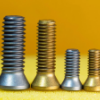
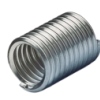
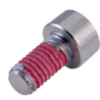
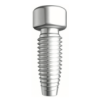
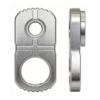
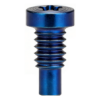
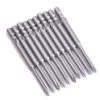
Stainless steel high lock nuts feature special locking structures such as closing and split groove designs, delivering stable fastening under vibration and heavy loads. They are critical connecting parts widely used in aerospace, wind turbine towers and high-end construction machinery. Nevertheless, cracking frequently occurs during production, assembly and service. Industry statistics show around 70% of cracking issues stem from improper process control and incorrect selection. To solve the problem fundamentally, it is necessary to clarify root causes and pinpoint defects. Below is a detailed analysis of four major causes.
I. Improper Material Selection: Mismatch Between Material Properties and Working Conditions
Material is the core factor determining crack resistance. Inappropriate selection or inherent material defects will bring hidden cracking risks.
First, mismatched material grades. Stainless steel grades differ greatly in mechanical properties and shall be selected strictly according to service conditions. As a free-cutting stainless steel, 303Se contains selenium to improve machinability, yet its ductility and radial load capacity drop sharply after cold working. Nuts made of 303Se via cold extrusion tend to crack along the axis during assembly. By contrast, 302 stainless steel has better ductility and avoids such failures under the same cold extrusion process. Though 17-4PH precipitation hardening stainless steel boasts high strength, insufficient aging treatment for high-temperature service will lead to unstable microstructure and reduced toughness, resulting in cracks in service.
Second, raw material defects. Excessive inclusions such as sulfides and oxides, component segregation and uneven grain distribution will form stress concentration points. Cracks initiate and propagate easily at these weak points during subsequent processing and loading. In a batch inspection of cracked 303Se high lock nuts, axially elongated internal inclusions did not directly cause cracking, but greatly impaired deformation resistance and accelerated crack development.
II. Manufacturing Defects: Residual Stress Formed During Processing
The production of high lock nuts includes multiple procedures with high precision requirements. Poor control in any process will induce residual stress and structural defects, and eventually cause cracking. Problems mainly exist in forming, closing and heat treatment processes.
Improper forming is a common inducement. Cold extrusion is a mainstream forming method that strengthens materials through cold deformation. Excessively high billet hardness or excessive deformation will reduce ductility and metal flow, leading to core cracks. In a failure case of 17-4PH high lock nuts, through-core cracks occurred due to billet hardness over 20 HV above standard plus excessive extrusion deformation. Besides, unreasonable cutting parameters in turning will produce high residual tensile stress on thread surfaces, which further expands into cracks under assembly load.
Stress concentration during closing is a key hidden danger. The locking performance relies on closing deformation. Unreasonable closing methods will cause severe stress concentration at deformed areas. For two-point closing, the short axis bears excessive unit load. Combined with sharp thread root, microcracks are likely to generate and expand rapidly under vibration, resulting in fatigue fracture. Vibration tests on aerospace superalloy high lock nuts revealed all cracks originated at short axis closing sections and penetrated internal threads for this reason.
Uncontrolled heat treatment parameters deteriorate material performance. Heat treatment including solution treatment, aging and annealing regulates material microstructure and properties. Inadequate solution treatment of 17-4PH restricts full austenite transformation; overhigh aging temperature reduces hardness and toughness. Cold-worked nuts without timely annealing retain massive residual stress. Superposition of such stress and assembly stress greatly raises cracking risks. Double annealing on extruded billets has been proven effective to lower hardness, release residual stress and eliminate processing cracks.
III. Improper Assembly & Application: Immediate or Delayed Cracking Induced by External Force
Even for qualified products, non-standard assembly is the most frequent on-site cause of cracking.
Excessive tightening torque and eccentric operation are direct triggers. Each type of high lock nut has a specified torque range. Over-tightening causes plastic deformation or cracking when load exceeds yield strength. Eccentric assembly leads to uneven force distribution and local stress concentration. In addition, the split groove is designed for one-time use. Failure to break the groove as required or repeated use breaks internal stress balance and causes cracking under load.
Mismatched mating parts and contaminated assembly environment also increase risks. Mating bolts with excessive hardness or substandard thread precision cause localized stress during meshing. Impurities like metal debris and grit embedded in thread contact surfaces form stress points. In a wind power project, nuts cracked shortly after assembly due to burrs on bolt threads that triggered overlocalized stress.
IV. Environmental Impact: Cracking Accelerated by Combined Corrosion and Load
Stainless steel has moderate corrosion resistance, yet combined action of corrosion and service stress in harsh environments mainly leads to delayed cracking during operation.
Stress Corrosion Cracking (SCC) is a typical failure mode. Nuts under residual or working stress tend to develop SCC in humid corrosive atmosphere, chloride-containing media or alternating wet-dry conditions. Cracks on 0Cr12Mn5Ni4Mo3Al high lock nuts were found starting from right-angle junctions between flange and nut body where liquid accumulates. Single passivation and MoS₂ coating failed to provide sufficient corrosion resistance. Local corrosion pits formed and cracks expanded along tangential tensile stress until fracture.
High temperature and thermal cycling alter microstructure and stress state. Long-term high-temperature service around aero-engines causes material aging and hardness decline. Thermal stress generated by thermal expansion and contraction superimposes on working stress to accelerate crack initiation. Repeated stress changes under frequent temperature cycles shorten fatigue life and bring about fatigue cracking.
Summary
Cracking of stainless steel high lock nuts is generally a combined result of improper material selection, manufacturing defects, non-standard assembly and adverse service environment. Troubleshooting is recommended in the following order: inspect assembly operations first, then trace manufacturing processes, and finally verify material and environmental adaptability.
Key preventive measures include selecting proper material grades for specific working conditions, strictly controlling cold extrusion deformation and closing processes, standardizing tightening torque and operation, and adopting upgraded surface treatments such as silver plating and enhanced passivation according to service environments. Mastering the above points can effectively avoid cracking risks and ensure reliable fastening performance of high lock nuts.





















 Login
Login








 Contact
 WeChat
 粤ICP备2025493240号-1