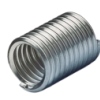
As the most traditional elastic anti-loosening washer, the spring washer generates lateral pressure through elastic deformation and increases the frictional resistance of the thread pair to achieve anti-loosening effects. Although gradually replaced by specialized anti-loosening washer sets on core load-bearing positions, it is still widely applied on non-core auxiliary components in rail transit equipment.
1. Structural Working Principle
Featuring a spiral structure, the spring washer is compressed and elastically deformed by bolt preload during assembly. The sustained elastic reaction force creates continuous lateral pressure between bolt heads and nuts, forming additional friction on thread pairs to resist rotational loosening. Meanwhile, the sharp edges of the washer slightly embed into the surface of connected parts, further enhancing anti-slip performance.
2. Core Advantages
It features an extremely simple structure, ultra-low cost and mature manufacturing and assembly processes. With excellent elastic deformability, it effectively absorbs minor vibration and compensates for assembly gaps. It offers wide compatibility and can be matched with most standard bolts without customized specifications.
3. Rail Transit Application Scenarios
It is mainly used for fixing low-vibration, non-load-bearing auxiliary components inside vehicles, including seat brackets, handrail fixation and cable tray assembly. It is also extensively applied to track auxiliary facilities such as signal equipment and guardrail connections. For instance, spring washers are commonly adopted for platform guardrail bolts in high-speed railway stations to satisfy basic anti-loosening demands while balancing cost and reliability.
4. Application Notes
Due to limited anti-loosening capacity, spring washers are prohibited for core load-bearing positions under high-frequency and high-intensity vibration, such as bogies and wheel-set axle boxes, to avoid safety risks caused by loosening failure. Preload must be strictly controlled during assembly; excessive preload leads to plastic deformation and permanent loss of elasticity. Material selection shall match service environments: stainless steel spring washers are preferred for outdoor applications to prevent corrosion and failure.
V. Rubber Anti-Loosening Washer — Specialized Integrated Sealing & Anti-Loosening Solution
The rubber anti-loosening washer is a specialized fastener component mainly made of rubber, integrating anti-loosening, sealing and cushioning functions. It is uniquely designed for humid, impurity-prone and sealing-required connection scenarios in rail transit systems.
1. Structural Working Principle
Rubber washers may adopt an internal metal skeleton in premium models to enhance load capacity. The high elasticity of rubber enables tight fitting between bolts and connected surfaces, eliminating assembly gaps and absorbing vibration energy. The high-friction rubber surface effectively restricts bolt rotation. In addition, the rubber body provides reliable sealing, blocking moisture, salt spray, dust and other corrosive media from invading thread pairs and preventing thread rusting and deterioration.
2. Core Advantages
It delivers outstanding sealing performance and adapts well to outdoor, humid and salt-laden rail transit environments, effectively protecting threaded connections from corrosion. The excellent cushioning and damping properties reduce vibration impact damage on connecting structures. Rubber materials feature favorable corrosion resistance and aging resistance for extended service life. Assembly is simple and tool-free, allowing direct installation onto bolts.
3. Rail Transit Application Scenarios
It is widely used for humid and impurity-exposed positions such as vehicle bottom drainage systems, brake pipeline connections and external accessory fixation. It is also extensively applied to outdoor electrical equipment including turnout switch machines and signal boxes along track lines. For example, rubber anti-loosening washers installed on brake pipeline joint bolts of high-speed EMUs effectively prevent vibration-induced loosening and block rain and snow infiltration, ensuring stable braking system operation.
4. Application Notes
Rubber materials have limited temperature adaptability. Appropriate rubber types shall be selected according to operating temperature — nitrile rubber for low-temperature environments and fluororubber for high-temperature conditions — and shall not be used on high-temperature components such as traction motors. Contact with oil stains and organic solvents must be avoided to prevent rubber swelling and failure. Preload force must be properly controlled to avoid permanent compression deformation and loss of elasticity and sealing performance.
VI. Core Principles for Selection and Application of Rail Transit Anti-Loosening Washers
Based on the operating characteristics of rail transit equipment and the technical features of various anti-loosening washers, the following core principles shall be followed to ensure reliable and compatible fastening solutions:
1. Graded Selection According to Working Condition Intensity
Specialized anti-loosening washer sets are prioritized for core load-bearing and high-frequency vibration positions such as bogies and wheel-set axle boxes to guarantee ultimate anti-loosening performance. Lock washers and wave washers are applied to medium-vibration and conventional load-bearing structures including car body frames and door systems. Spring washers are adopted for non-load-bearing auxiliary positions such as interior parts and guardrails to balance cost and basic anti-loosening requirements. Rubber washers are selected for humid, impurity-prone and sealing-demanding scenarios.
2. Material Matching with Environmental Requirements
Stainless steel washers are preferred for outdoor and coastal salt spray environments to prevent corrosion. High-temperature spring steel or fluororubber washers are used for high-temperature areas such as traction systems. Insulating rubber or plastic washers are applied to electrical component connections to avoid short-circuit risks.
3. Strict Control of Assembly Processes
Before assembly, oil stains and impurities on bolts, nuts and connected surfaces must be thoroughly cleaned to ensure flat and clean contact interfaces. Anti-loosening washer sets shall be installed in the correct direction; lock washer tabs must be fully bent in place; spring and wave washers must achieve sufficient elastic deformation. Preload force must comply with design specifications to prevent anti-loosening failure caused by excessive or insufficient tightening.
4. Full Lifecycle Management
Regular inspection shall be conducted on washers at core positions to check wear, deformation and corrosion. Disposable anti-loosening washers such as double-ear lock washers must be replaced after disassembly. Reasonable replacement cycles shall be formulated based on service environments and lifespan requirements to sustain stable anti-loosening performance.
Conclusion
Although anti-loosening washers are tiny components, they directly determine the reliability of threaded connections and the operational safety of rail transit equipment. Each type of anti-loosening washer has unique structural advantages and targeted application scenarios. Anti-loosening washer sets for core load-bearing positions, rubber washers for sealing requirements, and spring washers for auxiliary structures jointly form a multi-level anti-loosening fastening system for rail transit applications.
As rail transit equipment develops toward high speed and intelligence, higher standards are imposed on washer performance. High-strength, extreme-environment-resistant and long-life anti-loosening washers will represent the future development trend. Industry practitioners must accurately grasp the technical characteristics of different washers and implement scientific selection and standardized application according to actual working conditions, so as to build a solid and reliable anti-loosening guarantee for the safe operation of rail transit systems.















 Login
Login








 Contact
 WeChat
 粤ICP备2025493240号-1