Fasteners are essential components in manufacturing, widely used in automotive, aerospace, electronics, construction, and renewable energy sectors. Flow Drill Screwing: New Benchmark for Luxury Vehicle Fasten is a common question engineers and procurement specialists encounter. This article provides a systematic answer covering technical principles, selection methods, and practical guidelines.
From a technical perspective, this topic involves materials science, tribology, and surface engineering. Understanding the underlying principles helps engineers select appropriate fastener specifications, strength grades, and surface treatments during the design phase, preventing assembly failures and safety hazards.
In practical applications, evaluate working conditions including load type, ambient temperature, corrosive media, assembly space, and maintenance requirements. For critical joints, verify mechanical performance per ISO 898-1 standards and recheck torque after assembly.
Toprecision provides comprehensive solutions from standard parts to custom-engineered fasteners, covering high-strength bolts, micro screws, wire thread inserts, and self-clinching fasteners for EV, robotics, and AI server applications. Contact our engineering team for support.
Traditional fastening processes often face bottlenecks when dealing with closed profiles or joining dissimilar materials. Flow Drill Screwing breaks through these scenario limitations and process constraints with its unique friction-heat forming principle. Gaining an in-depth understanding of the core logic and application value of this technology will not only help practitioners seize the industry's technological windfall but also provide a clearer recognition of the pivotal role fasteners play in high-end manufacturing.
II. Flow Drill Screwing Technology: Principles and Core Advantages
Flow Drill Screwing, also known as the Flow Drill Screw (FDS) process, is essentially a cold-forming process. It achieves hole-free fastening through the synergistic effect of high-speed rotation and axial pressure. The entire procedure consists of six stages: rotation heating, penetration, through-hole formation, thread forming, thread tightening, and final setting. The whole cycle takes only 1 to 6 seconds to complete.
Its working mechanism is highly innovative: a servo motor drives the screw to rotate at high speed (up to 8000 rpm) while applying an axial pressure of up to 3500 N. The intense friction between the screw and the workpiece surface generates temperatures between 600°C and 900°C, causing the metal in the contact area to soften rapidly. The softened metal flows along the screw's taper. After penetrating the material, it forms a metal bushing beneath the workpiece that is 1 to 3 times thicker than the original sheet. The screw's threads simultaneously form within this bushing. Finally, it is tightened to a preset torque and held for a specific duration to establish a stable preload.
Compared to traditional fastening processes, its advantages are particularly prominent:
-
No Pre-drilling Required: It eliminates the preliminary steps of drilling and tapping, greatly simplifying the process and boosting production efficiency, while avoiding dimensional errors caused by pre-hole machining.
-
Single-Sided Operation: It perfectly solves connection challenges in scenarios where double-sided access is impossible, such as closed profiles and concealed areas, offering greater flexibility for automotive design.
-
Strong Compatibility: It enables the joining of dissimilar materials, including aluminum-to-aluminum, aluminum-to-steel, and composites like carbon fiber, aligning with the trend of mixed-material usage for vehicle lightweighting.
Additionally, the connection offers both detachability and high reliability, with anti-loosening capabilities and fatigue strength far exceeding traditional methods. Furthermore, because the heat is concentrated in the contact area, overall workpiece deformation is minimal.
III. The Top Choice for Luxury Cars: Automotive Applications of FDS
Amid the automotive industry's transition toward lightweighting and high precision, Flow Drill Screwing has become a standard process for luxury brands like BMW, Mercedes-Benz, and Audi due to its core advantages. It is widely used in the assembly of critical components such as body-in-white structures and battery packs.
European automakers began implementing this technology years ago. In high-end models like the Audi R8, A8, and TT Coupe, FDS plays a core role in joining dissimilar materials. It not only ensures the structural integrity of steel-aluminum hybrid bodies but also contributes to weight reduction and energy savings. BMW and Mercedes-Benz apply it to the assembly of closed-profile components and concealed areas, overcoming connection bottlenecks that traditional processes could not break through, while simultaneously enhancing overall vehicle assembly precision. Brands such as Jaguar, Land Rover, and Porsche have also followed suit, making this technology one of the hallmark processes in high-end automotive manufacturing.
In the domestic market, this technology is gradually gaining traction. During mass production, the NIO ES8 extensively adopted intelligent adaptive flow drill screwing systems to meet various connection demands of its all-aluminum body, validating the technology's adaptability in the new energy vehicle sector. When achieving localization of its steel-aluminum body-in-white, the Cadillac CT6 relied heavily on FDS to join 11 different materials, balancing body rigidity with lightweight goals and demonstrating the technology's core value in the localization of high-end vehicles.
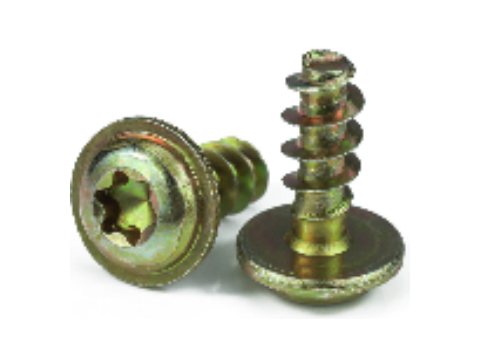
Notably, the preference of luxury automakers for this technology has also driven the upgrading of supporting fasteners. Specialized screws for flow drill screwing must be made from specially formulated hard alloys to withstand high temperatures and pressures. Although currently still reliant on imports, domestic enterprises are accelerating technological breakthroughs, laying the groundwork for import substitution in the industry.
IV. Technological Upgrades and Industry Impact
The proliferation of Flow Drill Screwing has not only altered the connection logic in automotive manufacturing but also propelled technological upgrades and equipment innovation within the fastener industry. Current mainstream intelligent adaptive flow drill screwing systems feature a "dual-servo + intelligent electric drive" design. They enable precise monitoring and adaptive adjustment of rotational speed, pressure, and displacement, remaining unaffected by tolerances in fasteners and connectors. This significantly reduces rework rates and shortens debugging time.
These intelligent systems also boast compact and modular advantages. They can be adapted for multi-angle robotic installation, support both blow-feed and magazine-style screw feeding, and integrate seamlessly into existing assembly lines. Compatible with new types of fasteners like Flow-push and Flow-plast, they are suited for joining new materials such as high-strength steel and carbon fiber, paving the way for broader technological applications. For fastener enterprises, delving into the R&D of specialized FDS screws and optimizing material formulations and processing techniques has become a crucial breakthrough point for entering the high-end manufacturing supply chain.
However, the application of this technology still faces certain challenges. Precise control of process parameters is vital to connection quality; excessively high or low parameters can lead to connection failure. Additionally, the high cost of specialized screws and the reliance on imported core equipment have constrained its large-scale adoption among domestic indigenous brands. These pain points represent both the direction for industry-wide technological breakthroughs and significant opportunities for fastener enterprises.
V. Conclusion
With its innovative process, Flow Drill Screwing has broken through numerous limitations of traditional fastening, establishing itself as a core connection technology in luxury car manufacturing and leading the fastener industry toward high precision, intelligence, and scenario-specific applications. For "screw experts," this technology is not merely a "new realm" of tightening screws; it highlights the core value of fasteners as the "industrial joints" in the upgrade of high-end manufacturing.
As domestic technological breakthroughs advance and the costs of equipment and fasteners decrease, Flow Drill Screwing is poised to extend beyond luxury vehicles into broader scenarios such as new energy vehicles, aerospace, and rail transit. In the future, only by keeping pace with technological trends and dedicating efforts to material R&D and process optimization can enterprises seize opportunities in this wave of fastening technology innovation, providing more reliable fastener solutions for high-end manufacturing.


 135-6073-0094