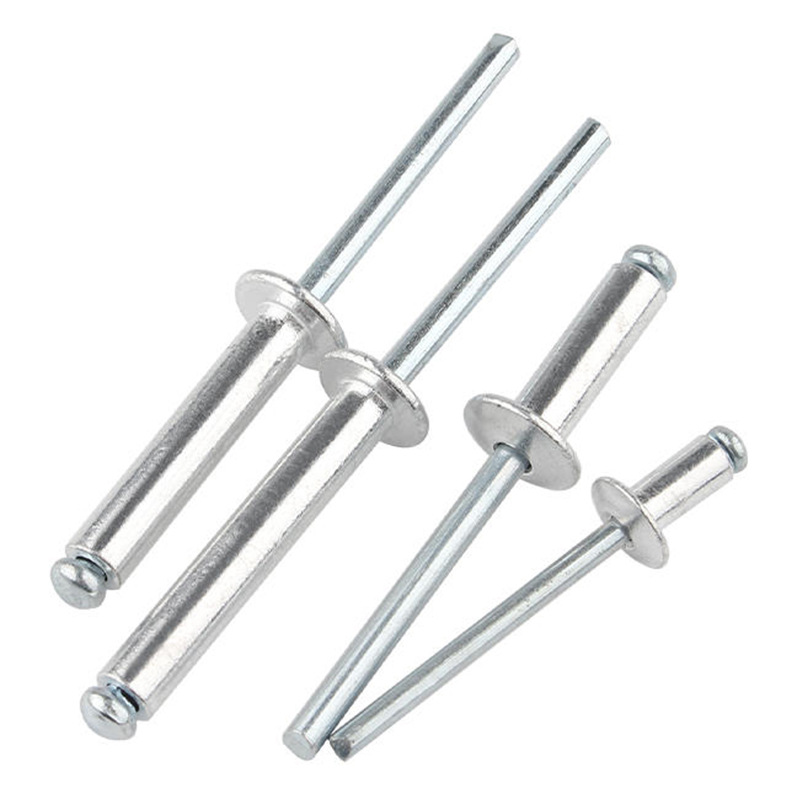
As a unique fastener featuring single-sided riveting, blind rivets serve as an essential solution for special assembly scenarios. Unlike conventional rivets requiring double-sided operation, blind rivets can be installed merely with professional riveting tools, including manual, electric and automatic riveters. They greatly expand application boundaries and are widely adopted in construction, automotive, marine, aerospace, machinery, electrical and furniture manufacturing industries.
1. Core Advantages
The widespread popularity of blind rivets in global manufacturing stems from their prominent performance strengths, which effectively solve the pain points of traditional riveting processes.
Single-sided installation is their most distinctive core advantage. They enable reliable fastening for enclosed structures, high-altitude operations and scenarios with only one accessible side, where double-sided conventional riveting is impossible, greatly reducing construction difficulty. In terms of compatibility, blind rivets deliver stable connection performance on metal, plastic and composite materials, as long as holes are prefabricated with standard sizes to fit diverse workpiece assembly demands.
In terms of efficiency, blind rivets support rapid installation. Skilled operators can complete single rivet fastening within seconds, far more efficient than the hammer-driven installation of traditional rivets. Mechanically, they generate strong clamping force to ensure tight joint fitting and excellent vibration resistance, performing stably in high-vibration scenarios such as automotive chassis and marine decks. Additionally, their smooth breaking ends guarantee neat workpiece surfaces, while superior locking structure ensures long-term connection reliability.
2. Standard Three-Step Installation Process
Blind rivets feature a simple and standardized installation procedure to guarantee consistent riveting quality, with three core steps:
Step 1: Preparation and positioning. Select rivets of suitable specifications according to workpiece thickness and material, load the rivet into the riveter nozzle, and insert it vertically into the pre-drilled hole to avoid offset and assembly deviation.
Step 2: Tool driving and deformation. Activate the riveter to apply axial tension on the mandrel. The rivet body expands and deforms to fully fill the prefabricated hole and achieve preliminary workpiece fixation.
Step 3: Locking and mandrel breaking. When the tool reaches the preset load, the mandrel breaks neatly at the designated position and is firmly locked inside the rivet body, forming a non-detachable and high-reliability joint without extra trimming.
3. Working Principle and Product Types
Blind rivets fasten workpieces relying on outward expansion force generated by mandrel pulling. During installation, the tapered tail of the tensioned mandrel expands the rivet body to closely fit the inner wall of the hole. The mandrel breaks under continuous tension and forms a rigid lock with the rivet body. Under external separating force, the mandrel and rivet cap jointly bear shear force to prevent joint failure.
Based on application requirements, blind rivets are classified into three mainstream types:
Open-type round head blind rivets: The most widely used type, suitable for general assembly scenarios with standard strength requirements.
Countersunk head blind rivets: The embedded head ensures flat and smooth workpiece surfaces, ideal for high-appearance scenarios such as furniture panels and electrical enclosures.
Closed-type blind rivets: Featuring excellent tightness and high load capacity, they are essential for leak-proof and high-strength applications including pipeline connections and pressure vessels.
4. Cold Riveting vs. Hot Riveting: Scenario Matching
Blind riveting is divided into cold riveting and hot riveting for different strength standards.
Cold riveting is conducted at room temperature with simple operation and high efficiency. It applies to most conventional working conditions, such as electrical component and furniture frame assembly.
Hot riveting is designed for ultra-high strength requirements, such as steel bridge beam connection. The rivet is preheated to red-hot state, inserted into the hole and fastened immediately. Cooling shrinkage generates additional pre-tension stress to achieve tighter, more stable and higher-load structural connections.



























 Login
Login









 Contact
 WeChat
 粤ICP备2025493240号-1