



















 Login
Login



Products
Solutions
Applications





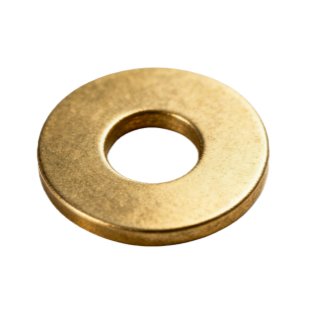
In fastener assembly, flat washers and spring washers directly determine connection stability and service life. This article systematically analyzes the scientific selection method for flat and spring washers based on function, selection dimensions, and application scenarios.
(1) Flat Washer: The Buffer Between Bolt and Workpiece
The flat washer solves mismatch problems between the bolt and the connected part through three core functions.
The first function is increasing contact area and dispersing compressive force. The bearing area of a bolt head or nut is small. When tightened directly onto soft materials such as aluminum alloy or plastic, or onto thin plates, the high unit pressure can cause surface indentation or deformation. An M12 bolt has a head bearing area of approximately 1.5 square centimeters. With a matching flat washer, the contact area expands to 3 to 4 square centimeters, significantly reducing unit pressure.
The second function is correcting assembly deviation and ensuring fit accuracy. Flat washers fill small gaps through their flatness, making bolt force uniform and avoiding stress concentration.
The third function is isolation for corrosion prevention and auxiliary positioning. In outdoor or humid environments, flat washers isolate direct contact between the bolt and workpiece, slowing electrochemical corrosion.
For flat washer selection, focus on three parameters: material, size, and performance grade. Low carbon steel flat washers suit ordinary conditions. Stainless steel flat washers suit humid or corrosive environments. Copper flat washers are used for electrical connections. For size, the inner diameter should be 0.1 to 0.3 millimeters larger than the nominal bolt diameter, and the outer diameter should be 1.5 to 2 times the inner diameter. For performance grade, a Grade 8.8 bolt should be paired with a flat washer having hardness above 100HV.
(2) Spring Washer: The Anti-Loosening Guard for Vibration Environments
The working principle of a spring washer is that after the bolt is tightened, the spring washer is compressed and generates continuous elastic reaction force, maintaining constant friction between the bolt threads to counteract vibration-induced loosening. At the same time, the sharp edges of the spring washer embed into the bolt head and workpiece surface to create mechanical interlocking.
For spring washer selection, evaluate vibration intensity, load type, and assembly space. Spring steel is suitable for ordinary conditions from minus 20 to 120 degrees Celsius. Stainless steel suits corrosive environments but has lower elasticity. For high temperature conditions such as engine compartments, Inconel alloy spring washers are required to maintain elasticity above 300 degrees Celsius.
Regarding size, the free height of a spring washer should ideally be 2 to 3 times its thickness. The inner diameter must precisely match the nominal bolt diameter.
Spring washers are necessary for high-frequency vibration applications such as motors, pumps, and fans. However, in precision instruments, low temperatures below minus 20 degrees Celsius, or static heavy-load scenarios, spring washers may fail due to elastic fatigue or embrittlement.
(3) Core Selection Logic: Three Dimensions
The first dimension is vibration and load characteristics. For no vibration or static load, flat washers alone are sufficient. For low-frequency mild vibration, spring washers alone may be used. For high-frequency strong vibration, flat washers and spring washers must be used together.
The second dimension is workpiece material and structure. For soft materials or thin plates, flat washers must be used regardless of vibration. For hard materials with thick walls, flat washers may be omitted when there is no vibration.
The third dimension is assembly precision and environmental requirements. For precision instruments, high-precision flat washers are preferred. For corrosive environments, stainless steel flat and spring washers of the same material must be used. For high temperature conditions, spring washers must be made of high-temperature alloy, and flat washers must match the thermal expansion coefficient.
(4) Common Selection Mistakes to Avoid
One mistake is adding spring washers for anti-loosening in every scenario. In static heavy-load scenarios, the elastic reaction force of a spring washer superimposes on the preload and accelerates fatigue fracture.
Another mistake is arbitrarily substituting flat washers. Using an oversized flat washer causes uneven force on the bolt head and increases loosening risk.
A third mistake is ignoring material matching. Pairing a carbon steel spring washer with a stainless steel bolt causes electrochemical corrosion and rust seizure in a short period.
In summary, flat washer selection focuses on pressure dispersion and precision correction, while spring washer selection focuses on vibration anti-loosening. The choice must be based on vibration intensity, workpiece material, and environmental conditions.
Professional consultant team online, ready to provide solutions for you
Contact NowProducts
Solutions
Applications
Contact
 Contact
 WeChat
Contact: Manager Fan - Tel/WeChat: 135-6073-0094 Email: Flora.Fan@toprecision.com | Manager Ao - Tel/WeChat: 13560729614 Email: Olia.Ao@toprecision.com
Sales Director: Mr. Zhang - Tel: 13510369429 Email: xiaowei.zhang@zcjtech.com
© Copyright 2011 - 2026 Shenzhen Toprecision Precision Technology Co., Ltd. All Rights Reserved.
 粤ICP备2025493240号-1

Cutter Screws
Thread Inserts
Sealing Products
Riveting Products
Locking Products
Direct Assembly
SMT Components
Precision Screws
Screwdriver Bits