Comparison of Anti-Loosening Solutions in Vibration Environm? This is a common technical question in fastener design and application. Understanding the relevant principles is essential for improving joint reliability and reducing failure risks.
Technically, this issue involves material selection, manufacturing processes, heat treatment, and surface treatment. The optimal solution varies under different conditions. For example, high-strength bolts require strict control of quenching and tempering parameters per ISO 898-1.
In practice: select appropriate strength grade based on load; understand friction coefficient effects on preload; choose appropriate locking methods (spring washers, thread locker, cotter pins); and periodically inspect torque on critical joints.
Toprecision's engineering team has extensive experience in cold forming, aluminum alloy fasteners, and micro screws. We provide comprehensive technical support from selection to application. Contact us with your specific questions.
I. Root Causes of Anti-Loosening Failure and Core Countermeasures
The fundamental mechanism of traditional threaded connections loosening under alternating loads is generally considered to be the slight relative sliding between the internal and external threads caused by transverse vibration, which leads to a gradual decay of preload. Therefore, the core objective of all anti-loosening solutions is to: resist or eliminate this relative sliding, or provide additional locking force after preload decays.
II. Principles and Comparison of Mainstream Anti-Loosening Solutions
1. Friction Locking Solutions
These solutions achieve anti-loosening by increasing or maintaining the friction between the thread pair or on the bearing surface.
-
Elastic Washers (e.g., Spring/Wave/Toothed Lock Washers): Utilize the spring force of the washer to compensate for partial preload loss, while using teeth or edges to bite into the contact surface to provide resistance. Advantages include low cost and simple installation; however, their anti-loosening capability is limited, they tend to fail under strong vibrations, and they may damage the contact surfaces. Typically used for general applications and not recommended for critical, high-vibration areas.
-
Double Nuts: Generate additional pressure within the thread pair through the opposing action of the main and jam nuts, thereby increasing friction. The structure is simple and reusable, but it increases axial dimensions and weight. Furthermore, the anti-loosening effect is highly dependent on the tightening process of both nuts, making precise preload control challenging.
-
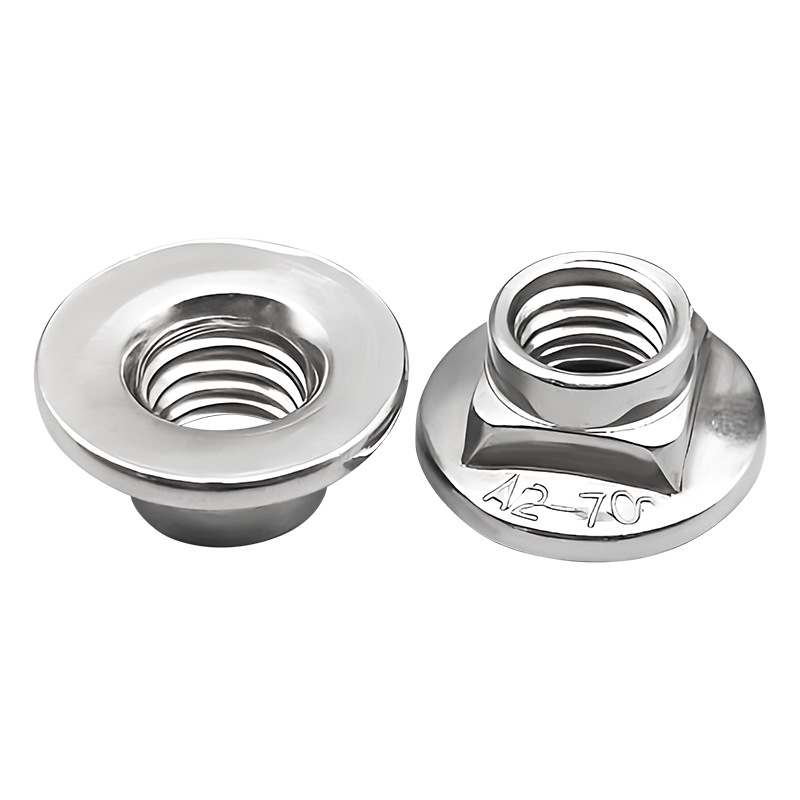
Prevailing Torque Nuts (Nylon Insert / All-Metal Locking Nuts): A nylon ring is embedded at the top of the nut, or the metal threads are partially deformed (e.g., Spiralock nuts), generating a continuous additional friction torque during engagement. They offer reliable anti-loosening and can be reused several times, making them widely adopted in aerospace and automotive fields. However, nylon insert nuts are limited by temperature (typically below 120°C) and have specific requirements for thread tolerances.
2. Mechanical Locking Solutions
These solutions prevent the relative rotation of the thread pair by introducing direct mechanical interference.
-
Castle Nut with Cotter Pin: After tightening the nut, a cotter pin is inserted through the hole in the bolt shank and the slot in the nut to secure it. This is a highly reliable traditional mechanical locking method with absolute anti-loosening security. However, assembly is cumbersome, requiring pre-drilled holes and slots, and parts usually need replacement after disassembly.
-
Safety Wire (Wire Locking): Steel wire is used to thread through the head holes of a group of fasteners, constraining them against each other. Commonly used for bolt groups in compact spaces like aerospace engines, it effectively prevents individual loosening but demands high standards for wiring craftsmanship.
-
Tab Washers (Internal/External Tab Lock Washers): One side of the washer is bent to engage with a groove in the part, while the other side is bent flat against the nut's side. Installation requires specific structures, offering good anti-loosening effects, but they are typically single-use.
3. Permanent / Deformation Locking Solutions
Achieve an "irremovable" lock by inducing permanent plastic deformation in the threaded connection pair or using chemical adhesives.
-
Staking, Punching, Welding: After tightening, local destructive locking is performed on the thread end or the junction of the nut and bolt. This offers absolute anti-loosening reliability but constitutes a non-detachable connection, requiring the destruction and replacement of the fastener during maintenance.
-
Threadlocking Adhesives (Anaerobic Adhesives): Applied to the thread surface, it cures when deprived of air, forming a thermosetting plastic that fills the thread aps, providing both mechanical locking and sealing. It offers excellent anti-loosening and sealing effects while preventing fretting corrosion. Different strength grades (low, medium, high) can be selected as needed. Attention must be paid to surface cleanliness control and curing time.
4. Structural Anti-Loosening Solutions (Addressing the Root Cause)
Avoid or reduce the loads that cause loosening through design.
-
Increasing Joint Stiffness: Using high-strength bolts, reducing bolt shank length, and increasing the thickness of connected parts to enhance system stiffness, thereby minimizing deformation and relative sliding under identical loads.
-
Optimizing Preload Control: Ensuring and maintaining a sufficient and precise initial preload is the foundation of resisting loosening. Advanced tightening processes like the torque-angle method and hydraulic tensioners guarantee preload accuracy far better than traditional torque methods.
III. Solution Selection Recommendations
Shenzhen Yongjing Precision Technology Co., Ltd. recommends that the selection of an anti-loosening solution should be based on a comprehensive decision across the following dimensions:
-
Vibration Intensity and Spectrum: Low-frequency large-amplitude versus high-frequency small-amplitude vibrations pose different challenges to various anti-loosening solutions.
-
Maintainability Requirements: Is frequent disassembly required? This determines whether permanent anti-loosening methods can be used.
-
Working Environment: Temperature and corrosive media will affect the performance of nylon components, adhesives, and metals.
-
Cost and Space Constraints: Comprehensively consider initial costs, installation costs, maintenance costs, and available installation space.
-
Reliability Level: Is it a critical safety connection?
-
For General Anti-Loosening: Elastic washers or double nuts can be chosen.
-
For Strong Vibrations & Detachable Connections: Prevailing torque locking nuts or medium-to-low strength threadlocking adhesives are preferred.
-
For Extreme Vibrations & Critical Safety Connections (Non-detachable): Consider mechanical locking (cotter pins, safety wire) or a combination with threadlocking adhesives.
-
For Connections Requiring Sealing: Threadlocking adhesives are the ideal choice.
Conclusion: There is no one-size-fits-all anti-loosening solution. The most reliable design is often a "combination blow," such as "high-strength bolts + precise preload control + high-performance locking nuts." Shenzhen Yongjing Precision Technology Co., Ltd. not only provides a wide range of anti-loosening fastener products but also assists clients in analyzing operating conditions, recommending, or customizing integrated anti-loosening solutions to safeguard connection safety from the source.


 135-6073-0094