Fastener Locking Methods and Selection Guide? This is a common technical question in fastener design and application. Understanding the relevant principles is essential for improving joint reliability and reducing failure risks.
Technically, this issue involves material selection, manufacturing processes, heat treatment, and surface treatment. The optimal solution varies under different conditions. For example, high-strength bolts require strict control of quenching and tempering parameters per ISO 898-1.
In practice: select appropriate strength grade based on load; understand friction coefficient effects on preload; choose appropriate locking methods (spring washers, thread locker, cotter pins); and periodically inspect torque on critical joints.
Toprecision's engineering team has extensive experience in cold forming, aluminum alloy fasteners, and micro screws. We provide comprehensive technical support from selection to application. Contact us with your specific questions.
Mechanical locking restricts the relative rotation of the threaded pair through additional structures. It offers high reliability and is suitable for scenarios with severe vibration, including cotter pin locking, tab washer locking, and wire locking. Cotter pin locking is the most classic mechanical method, where a cotter pin is passed through a hole at the bolt tail and the nut slot, then the tail is bent to fix it. Suitable for bolts with drilled heads, such as automotive wheel hub bolts, its advantage is reliable locking; the disadvantage is that removal requires destroying the cotter pin, making it suitable only for one-time fastening. For example, main shaft bolts on a certain wind turbine using a "cotter pin + double nut" combination showed no loosening during Level 10 gale tests, achieving a service life of over 10 years.
Tab washers are divided into single-tab, double-tab, and external-tongue washers. They limit rotation by engaging the washer tabs with the bolt head and nut, suitable for static or light-vibration scenarios like motor end cover bolts. Wire locking involves passing steel wire through small holes in multiple bolt heads to form an interlocking structure, preventing individual bolts from loosening. Widely used for internal combustion engine cylinder head bolts, it requires strict attention to the wiring sequence, as incorrect wiring will lead to locking failure. The common advantages of mechanical locking are low cost and ease of implementation; the disadvantages are higher requirements for installation skills, and it is not suitable for parts requiring frequent disassembly.
Friction locking prevents loosening by increasing the friction between threaded pairs. It allows for easy disassembly and is the most widely applied method, including spring washers, double nuts, and lock nuts. Spring washers generate preload through elastic deformation during tightening, keeping pressure between the threads. Suitable for non-critical areas of ordinary machinery, costing only about $0.007 per piece, they easily fail under high-frequency vibration and are unsuitable for engines. Double nuts generate opposing friction by tightening the main and secondary nuts. The locking effect is better than spring washers, used for machine tool guide rail fixation, but increases the required bolt length and weight.
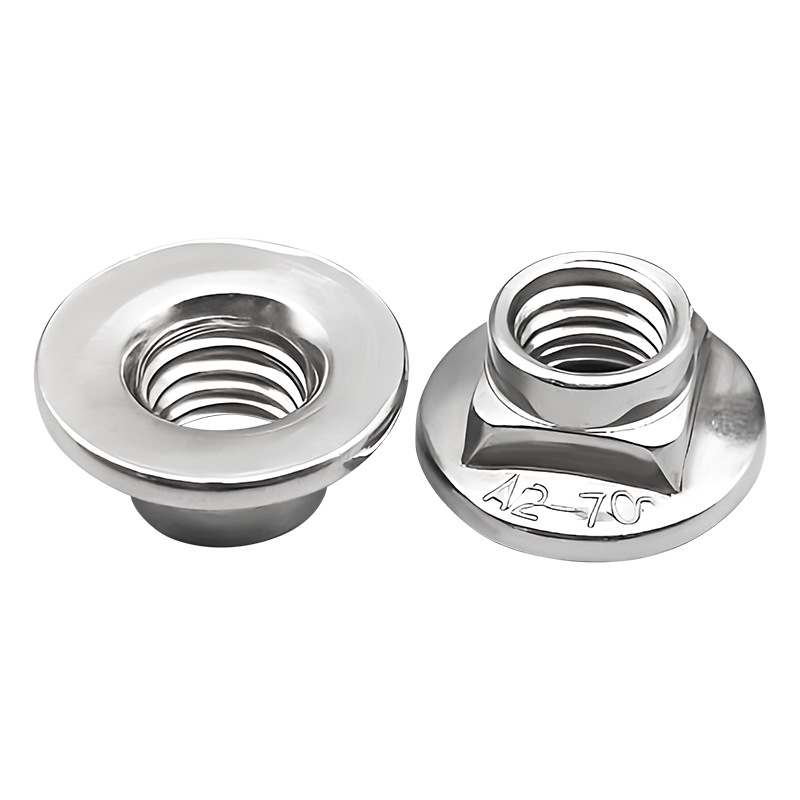
Lock nuts are an upgraded solution for friction locking, divided into nylon insert lock nuts, metal patch lock nuts, and prevailing torque lock nuts. Nylon insert lock nuts generate resistance through the interference fit between the nylon ring and the threads. Withstanding up to 500 hours in salt spray tests, they are suitable for humid environments like bathroom fixtures, costing around $0.04-$0.07 per piece. Metal patch lock nuts use built-in deformed metal patches to grip the threads and can be reused 5-8 times. Used in automotive transmissions, one automaker reduced its bolt loosening rate from 5% to 0.2% after adoption. Prevailing torque lock nuts feature special thread structures that maintain stable tightening torque, suitable for smart assembly lines. Products from Zhejiang Sijin Machinery are deployed at Tesla's Shanghai Gigafactory, enabling fully automated locking assembly.
Permanent locking achieves irreversible fastening by altering the threaded pair or using filling media, intended for permanent connections that do not require disassembly, including welding, adhesives, and indentation. Welding locks the nut and bolt into a single unit. The locking effect is absolutely reliable, used for permanent nodes in bridge steel structures, but cannot be disassembled and welding easily causes stress concentration. Adhesive (threadlocking) involves applying anaerobic adhesive between the threads. After curing, it forms an adhesive layer that locks the threads. Suitable for precision connections in electronic devices, such as mobile phone motherboard screws, disassembly requires heating above 200℃ to soften the adhesive layer. Indentation (staking) involves using a punch to create 3-4 indentations at the junction of the threaded pair after tightening, causing metal deformation to lock it. Used for fixing motors in home appliances, it costs only about $0.003 per piece, but has a certain impact on bolt strength.
Scenario-based selection should follow the "Vibration Intensity - Disassembly Frequency - Cost" three-dimensional model: for severe vibration (e.g., engines, wind turbines), prioritize mechanical locking combined with lock nuts; for moderate vibration (e.g., machine tools, automotive chassis), choose nylon insert lock nuts; for static scenarios (e.g., construction, furniture), choose spring washers or double nuts; for permanent connections (e.g., bridges, large equipment), choose welding or adhesive locking. One construction machinery plant optimized its classification and selection, reducing annual fastener loosening failures from 30 incidents to just 2, and cutting maintenance costs by 70%.


 135-6073-0094