















 Login
Login






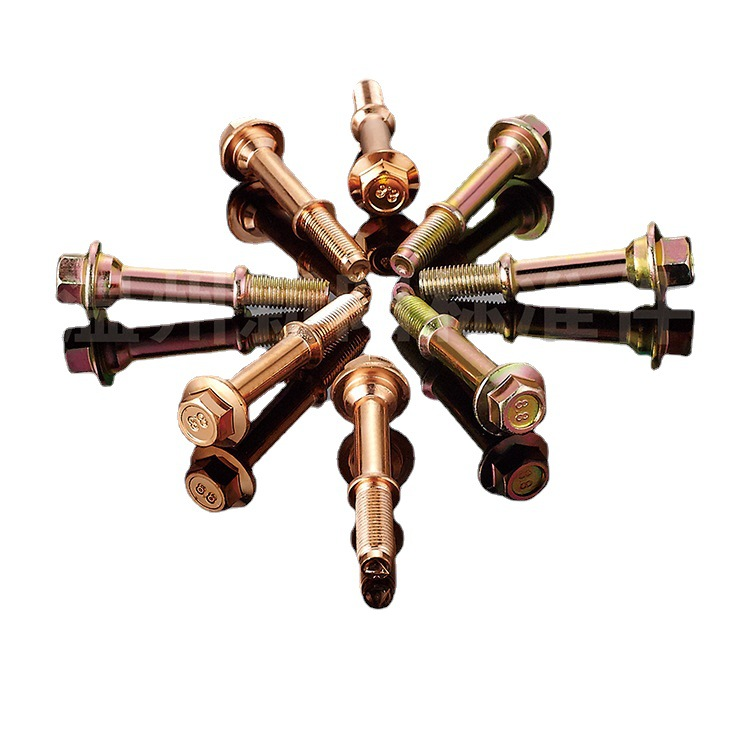
In the wave of automotive industry upgrading toward lightweight and high-end design, the reliability of high-strength fasteners directly impacts vehicle safety and performance, making it a core focus of industry technical development. The latest information from the National Intellectual Property Administration shows that Nantong Safety Hardware Technology Co., Ltd. has successfully obtained a utility model patent titled "A High-Strength Automotive Bolt Fastener," with authorization announcement number CN223563235U and an application date of January 2025. Through innovative structural design, this patent effectively solves the industry pain point of automotive bolts being prone to loosening, providing a new path for the high-end development of automotive fasteners.
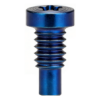
According to the patent abstract, the core structure of this high-strength automotive bolt fastener consists of a screw shaft and a connector head. The top of the screw shaft is fixed to the bottom of the connector head. The key innovations focus on a limiting component on the inner side of the screw shaft and a connecting component on the outer side. This dual-control structural design fundamentally solves the problem of traditional automotive bolts loosening under long-term vibration environments, filling a gap in existing technology regarding high-strength connection stability.
The working principle of the limiting component is quite ingenious. After the bolt is installed, an adjustment block drives a threaded rod to rotate, which then drives a threaded sleeve to slide forward along the axial direction. Due to the curved surface design of the threaded sleeve, it continuously compresses a driving column during sliding, causing it to slide outward along the inner side of a driving groove. Ultimately, the driving column pushes a limiting piece through a first connecting hole, pressing tightly against the inner wall of the automotive component, creating a firm locking effect that completely eliminates loosening caused by gaps between components, securing connection stability from the inside.
The external connecting component perfectly complements the limiting component, focusing on the critical aspect of nut fixation. During vehicle operation, bolts in areas such as the engine and chassis endure continuous vibration, and traditional nuts are highly prone to loosening. The connecting component in this patent uses a special snap-fit or elastic compression design to provide comprehensive reinforcement of the nut. Even under high-intensity vibration environments, it ensures that the connection precision between the nut and the screw shaft does not degrade, further enhancing the overall reliability of the bolt fastener.
A representative of Nantong Safety Hardware Technology Co., Ltd. stated that this patented technology is the result of two years of research and development, having undergone hundreds of vibration simulation tests and real-vehicle installation validations. Its strength indicators far exceed industry standards, and it can be widely applied to critical connection points in various vehicle types, including new energy vehicles, heavy-duty trucks, and high-end passenger cars. Currently, several automotive parts companies have expressed interest in cooperation, planning to commercialize this patented technology into mass-produced products.
Industry experts point out that although automotive fasteners are small components, they carry significant safety implications, and their technical level directly affects the core competitiveness of the automotive industry. The patent obtained by Nantong Safety not only demonstrates the company's independent innovation capability but also advances China's high-strength automotive fastener technology toward international advanced levels. With the industrial application of this patented technology, it is expected to further reduce the automotive industry's dependence on imported high-end fasteners, injecting new momentum into the high-quality development of manufacturing.



 粤ICP备2025493240号-1