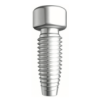
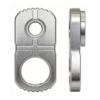
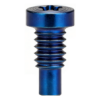
As a key technological innovation in the fastener field, the patent achieves the detachable function of the fastener through a unique structural design. Its core structure comprises two main components: a fastening sleeve and a fastening pin. The precise coordination of these two components constitutes the core highlight of the technological innovation.
Core Structure Analysis: Dual-Component Synergy for Detachability
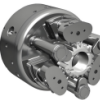
The patent abstract indicates that the main body of the fastening sleeve is a cylindrical portion, consisting of a cylinder and a pressing head. The design of the pressing head is one of the key innovations. At least two separation slots are set on the pressing head, providing the necessary deformation space for it and creating a structural foundation for subsequent disassembly. Meanwhile, the end of the pressing head is equipped with a pressing ring extending along the central axis of the cylinder, which serves as the core contact component for connecting with the fastening pin.
The matching fastening pin includes a pressing section, on which at least one groove is opened. The core function of the groove is to engage with the pressing ring of the fastening sleeve, thereby achieving a stable connection between the two. Notably, the interior of the groove is equipped with an abutting surface that abuts against the pressing surface of the pressing ring. It is the special angle design of these two contact surfaces that creates the detachable characteristic of the fastener.
Technical Key: Line Contact Replaces Surface Contact to Break the Bottleneck
The core issue that makes traditional fasteners difficult to disassemble often lies in the surface contact design between connected components. Surface contact leads to greater friction and biting force, making disassembly prone to jamming or component damage. The detachable fastener developed by Han Gong Intelligent Industry has achieved a key breakthrough by optimizing the angle of the contact surfaces.
In the patent design, the angle between the contour line of the abutting surface of the groove and the central axis of the fastening sleeve is smaller than the angle between the contour line of the pressing surface of the pressing ring and the central axis. This angle difference ensures that when the two contact surfaces meet, they form a line contact state rather than traditional surface contact. Line contact not only guarantees sufficient fastening force during assembly to meet usage requirements but also significantly reduces friction during disassembly, making component separation smoother and fundamentally solving the problem of detachability from a structural principle.
Industry insiders state that this patented technology is of great significance for equipment fields that require frequent assembly and disassembly, such as mechanical equipment maintenance, automotive parts replacement, and electronic equipment assembly. It ensures assembly stability while improving maintenance efficiency and reducing component wear caused by disassembly difficulties, and is expected to be widely applied across multiple downstream industries. Currently, the patent is in the public stage, and its subsequent industrialization is worthy of industry attention.



















 Login
Login








 Contact
 WeChat
 粤ICP备2025493240号-1