














 Login
Login



Products
Solutions
Applications


Tool Screws
Thread Inserts
Sealing Products
Riveting Products
Locking Products
Direct Assembly
UQD
SMT Chips
Precision Screws
Screwdriver Bits
Other Screws
Tool Screws
High-precision cutting fit, firm fastening, ensuring stable tool operation
Thread Inserts
Expert in precision thread repair, high strength and durability, stable locking without loosening
Riveting Products
Integral riveting molding, firm connection, compression resistant and not easy to loose
Locking Products
Multiple locking and anti-loosening, shockproof and stable, resist vibration for continuous fastening
Direct Assembly
Auxiliary-free convenient assembly, precise alignment, simplified process for efficient installation
UQD
Quick release buckle design, smooth docking, easy disassembly and assembly, universal efficiency
SMT Chips
Precision chip fitting, flat adhesion, suitable for automated mounting operations
Precision Screws
Micron-level precision molding, standard size, suitable for various precision components
Screwdriver Bits
High-precision bits, strong toughness and wear resistance, precise engagement for efficient operation
Others
Universal specification fit, stable fastening, meet various conventional assembly needs
Engineering Plastics
Light Alloys

PCB Applications
Sheet Metal Applications

Hard Alloys
Locking Applications
Lightweight Applications

Waterproof Sealing
Multi-function Applications
Surface Treatment

Miniature Precision
Ultra-high Strength Bolts

Magnesium Alloy Galvanic Corrosion

Humanoid Robots
Carbon Fiber Materials
 Ask me anything
 Contact information for headquarters sales
Contact information for Indonesia sales
Contact information for India sales
Contact information for headquarters sales
Contact information for Indonesia sales
Contact information for India sales



Thread Inserts

Screwdriver Bits

Inserts

Riveting Products

Locking Products

Direct Assembly

SMT Chips

Precision Screws

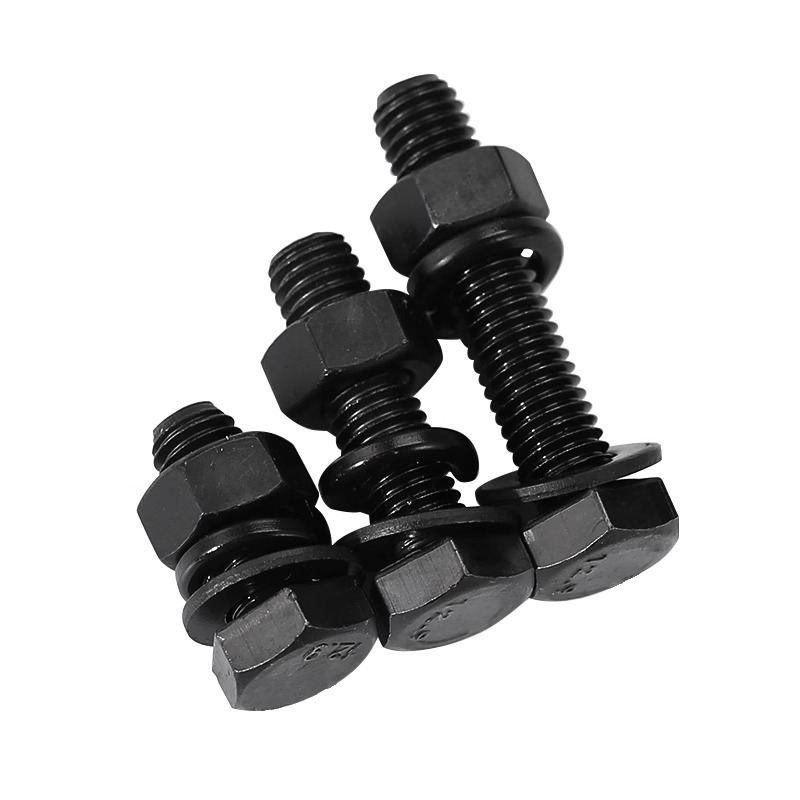
In heavy-load connections of wind power flanges, in cylinder head fastening of automotive engines, and in precision assembly of aerospace equipment, high-strength bolts are indispensable as the "industrial backbone." A grade 12.9 high-strength bolt can achieve a tensile strength of over 1200 MPa, capable of withstanding a pulling force equivalent to 12 tons. The core of this extreme performance lies in the precise selection of materials combined with the quenching and tempering process. For high-strength bolts of grade 8.8 and above, the industry standard is to use a quenching and tempering process (quenching + high-temperature tempering). Material selection is by no means a simple matter of "choosing steel"; rather, it is a systematic engineering task that must strictly match standard requirements, mechanical properties, and service conditions. This article starts with core standard requirements and provides an in-depth analysis of mainstream materials, elemental influences, and material selection logic for high-strength bolts, offering professional guidance for industry practitioners.
When discussing high-strength bolt materials, the first thing to clarify is the core constraints of the standards. Although relevant standards (such as GB/T 3098.1 and ISO 898-1) are relatively broad in their overall material requirements and do not mandate specific steel grades, they have clear and strict regulations on the content of key elements. Among these, the four major elements — carbon (C), phosphorus (P), sulfur (S), and boron (B) — are the "performance cornerstones." These four elements directly determine the hardenability, mechanical properties, and service safety of bolt materials, and are the core basis for manufacturers to select materials and for users to verify materials.
Carbon is the "strength core" of high-strength bolt materials. Its content directly determines the hardness and tensile strength of bolts after quenching and tempering. Although the standards do not specify a uniform upper limit for carbon content, according to long-term industry practice, the carbon content for grade 8.8 bolts and above is typically controlled between 0.25% and 0.55%. Low carbon content (0.25%-0.35%) materials such as 35 steel, after quenching and tempering, can achieve tensile strengths of 800-1000 MPa, suitable for grade 8.8 bolts. Medium carbon content (0.35%-0.45%) materials such as 40Cr and 42CrMo, after quenching and tempering, achieve tensile strengths of 1000-1200 MPa, making them the mainstream choice for grade 10.9 bolts. High carbon content (0.45%-0.55%) materials such as 45 steel require alloying element strengthening and, after quenching and tempering, can be used for grade 10.9 bolts, but with slightly lower toughness than alloy steels. It is worth noting that higher carbon content is not always better; excessively high carbon content increases material brittleness and the risk of cracking during quenching. Therefore, carbon content must be coordinated with alloying elements.
Phosphorus and sulfur are "harmful impurities" in materials. The standards have strict upper limits on their content — typically phosphorus ≤ 0.035% and sulfur ≤ 0.035%. For high-end bolts such as grade 12.9, the requirements are even more stringent (phosphorus ≤ 0.030%, sulfur ≤ 0.025%). Phosphorus significantly reduces low-temperature toughness, making bolts prone to brittle fracture in low-temperature environments, posing especially high risks in outdoor low-temperature scenarios such as wind power and rail transit. Sulfur forms sulfide inclusions, disrupting material continuity and reducing the fatigue strength of bolts, leading to early failure under high-frequency vibration conditions. Therefore, high-quality high-strength bolt materials all use low-phosphorus, low-sulfur smelting processes. Some high-end materials further reduce impurity content through secondary refining.
Boron is a "low-cost strengthening agent" for high-strength bolt materials. The standards permit the addition of trace amounts of boron (0.0005%-0.005%) to improve hardenability. Boron delays pearlite transformation, allowing bolts to achieve a uniform martensitic structure even when using slower cooling methods such as oil cooling during quenching, thereby improving the comprehensive mechanical properties after quenching and tempering. For large-diameter (≥20 mm) high-strength bolts, boron plays a particularly critical role. Without boron, the core of large-diameter bolts is prone to insufficient hardenability, leading to inadequate core strength. Adding trace amounts of boron ensures uniform core and surface properties. A common boron-containing material, 20MnTiB, is a typical choice for grade 8.8 bolts, offering lower cost than alloy steels while meeting medium strength requirements.
In actual production, the focus of attention between manufacturers and users differs, but both revolve around the core logic of "standard compliance + performance matching." Manufacturers are more concerned with machinability and quenching and tempering stability. For example, smelting quality and rolling precision affect cold heading formability and heat treatment uniformity. Users focus more on mechanical properties and working condition adaptability, such as corrosion resistance in corrosive environments or thermal stability under high-temperature conditions. This two-way focus drives the development of high-strength bolt materials toward greater precision.
Combining strength grades with working condition requirements, the mainstream materials for high-strength bolts can be divided into three major categories, each with clear performance positioning and application scenarios.
The first category is high-quality carbon structural steel, represented by 45 steel and 35 steel, primarily used for grade 8.8 bolts. 45 steel has a carbon content of 0.42%-0.50%. After quenching and tempering (quenching at 840°C + tempering at 550°C), its tensile strength can reach over 800 MPa, with yield strength ≥640 MPa, fully meeting grade 8.8 requirements. Its advantages are low cost and mature smelting processes, suitable for non-extreme conditions such as building steel structures and general machinery. However, the hardenability of 45 steel is poor; for diameters exceeding 16 mm, core strength decreases significantly, so it is mainly used for small-size grade 8.8 bolts. 35 steel has a slightly lower carbon content (0.32%-0.40%). After quenching and tempering, its toughness is better than that of 45 steel, making it suitable for grade 8.8 scenarios with higher toughness requirements, such as bridge bearing bolts.
Professional consultant team online, ready to provide solutions for you
Contact NowProducts
Solutions
Applications
Contact
 Contact
 WeChat
Contact: Manager Fan - Tel/WeChat: 135-6073-0094 Email: Flora.Fan@toprecision.com | Manager Ao - Tel/WeChat: 13560729614 Email: Olia.Ao@toprecision.com
Sales Director: Mr. Zhang - Tel: 13510369429 Email: xiaowei.zhang@zcjtech.com
© Copyright 2011 - 2026 Shenzhen Toprecision Precision Technology Co., Ltd. All Rights Reserved.
 粤ICP备2025493240号-1
Cutter Screws
Thread Inserts
Sealing Products
Riveting Products
Locking Products
Direct Assembly
SMT Components
Precision Screws
Screwdriver Bits