









One-stop Fastener
Custom Manufacturing Expert
Ask me anything
  • Contact information for headquarters sales
  • Contact information for Indonesia sales
  • Contact information for India sales

Bolt Failure Analysis: Ignored Risks in Installation Procedu

[Abstract]:As core connecting components in industrial equipment, bolts largely determine operational safety and structural stability.
Bolt Failure Analysis: Ignored Risks in Installation Procedu
As core connecting components in industrial equipment, bolts largely determine operational safety and structural stability. In practical service, bolt failures such as fracture, loosening and corrosion occur frequently. Industry statistics show that approximately 60% of bolt failures are directly caused by improper installation operations. Nevertheless, most conventional failure analyses focus merely on material and manufacturing defects while ignoring on-site installation factors, resulting in inaccurate root cause identification and repeated failure risks. This article summarizes typical failure cases, analyzes multi-dimensional causes, and proposes targeted prevention strategies.

I. Typical Bolt Failure Modes and Engineering Cases

Bolt failures manifest in various forms under different working conditions, among which fracture, loosening and corrosion are the most common.
Bolt Fracture Caused by Uncontrolled Preload
In a wind power project, multiple hub connecting bolts fractured within three months of operation. Third-party inspection verified qualified material composition and hardness, leading to ambiguous preliminary conclusions. Further on-site investigation confirmed that some bolts were tightened without standard torque wrenches, with actual preload only reaching 60% of the designed value. Insufficient and uneven preload induced alternating stress and eventually fatigue fracture.
Mass Loosening Caused by Incorrect Tightening Sequence
Batch loosening of flange bolts occurred in a chemical pipeline system, causing medium leakage and equipment shutdown. Initial inspection suspected manufacturing defects, while on-site review revealed that constructors adopted sequential clockwise tightening instead of standard cross symmetrical pre-tightening. The irregular sequence caused unbalanced flange stress and gradual sealing surface deformation, leading to continuous bolt loosening under operational vibration.
Corrosion Failure Due to Substandard Installation Treatment
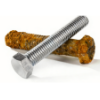
In marine engineering environments, installation irregularities significantly accelerate corrosion. The connecting bolts of a sea-crossing bridge pier suffered severe rusting and peeling within only two years. The root cause was incomplete removal of salt contaminants on fitting surfaces and non-compliant anti-corrosion coating during installation, which destroyed the protective system and induced rapid electrochemical corrosion.

II. Multi-Dimensional Analysis of Bolt Failure Causes

Bolt failure is generally attributed to superposed defects in design, material, manufacturing and on-site installation. Among them, non-standard installation is the most easily neglected acquired factor.
1. Design Defects (Inherent Hidden Risks)
Improper load calculation and inaccurate model selection leave inherent safety hazards. If the bolt strength grade is insufficient for actual impact load, vibration load and alternating load, or the thread structure is unreasonably designed, premature failure will occur. For example, ordinary high-strength bolts applied on hydraulic supports without anti-vibration design suffered batch fracture within half a year due to unconsidered impact fatigue.
2. Material and Processing Defects (Manufacturing Risks)
Excessive harmful elements such as sulfur and phosphorus, unqualified carbon content and improper heat treatment lead to coarse grain structure, reduced toughness and decreased fatigue resistance. Unstandard thread rolling and excessive surface roughness increase assembly friction, cause preload deviation, and accelerate surface corrosion susceptibility.
3. Non-Standard Installation (Dominant Acquired Failure Cause)
Installation errors are the primary trigger of field failures, including insufficient or excessive preload, disordered tightening sequence, unclean fitting surfaces, improper gasket selection, and repeated reuse of old bolts. In a steel structure construction project, damp bolts were installed directly with aged gaskets retained. Low-temperature ambient conditions caused gap generation on fitting surfaces, resulting in structural loosening and overall connection instability.

III. Key Suggestions for Bolt Failure Prevention

Comprehensive full-process control is essential to eliminate bolt failure risks.
1. Design and Manufacturing Control
Designers shall conduct precise load calculation and select bolt grades matching actual working conditions, with clear specification of installation requirements. Manufacturers must strengthen raw material inspection, optimize heat treatment processes, and improve thread machining accuracy and surface quality to ensure inherent mechanical performance and corrosion resistance.
2. Standardized On-Site Installation Management
Strengthen operational training for construction personnel. Standardize the use of professional tools such as torque wrenches and angle gauges, and strictly implement cross symmetrical pre-tightening and multi-stage tightening procedures. Thoroughly clean fitting surfaces, replace aging gaskets, avoid reuse of fatigued bolts, and complete standardized anti-corrosion treatment after installation.
3. Scientific Failure Analysis Logic
Failure evaluation shall abandon the single laboratory detection mode and combine material testing data with on-site installation records, construction environment and load characteristics for comprehensive judgment. Full-process traceability covering design, manufacturing and installation helps accurately locate failure roots, effectively avoid repeated failures, and improve the overall safety and reliability of mechanical connections.

Professional consultant team online, ready to provide solutions for you

Contact Now
WeChat

WeChat

Scan to add WeChat

Long press to scan

Service