Rail Transit Fastener Safety: Protecting Urban Arteries? This is a common technical question in fastener design and application. Understanding the relevant principles is essential for improving joint reliability and reducing failure risks.
Technically, this issue involves material selection, manufacturing processes, heat treatment, and surface treatment. The optimal solution varies under different conditions. For example, high-strength bolts require strict control of quenching and tempering parameters per ISO 898-1.
In practice: select appropriate strength grade based on load; understand friction coefficient effects on preload; choose appropriate locking methods (spring washers, thread locker, cotter pins); and periodically inspect torque on critical joints.
Toprecision's engineering team has extensive experience in cold forming, aluminum alloy fasteners, and micro screws. We provide comprehensive technical support from selection to application. Contact us with your specific questions.
I. The Framework of the Rail Transit Fastener Standard System
The standard system for rail transit fasteners is a multi-level, international framework, with its core including:
-
International Standards (ISO): Providing the foundational framework and general requirements.
-
European Standards (EN): Currently the most influential and comprehensive standard system globally in the rail transit field, such as the EN 15048 (Non-preloaded structural bolting) and EN 14399 (High-strength structural bolting for preloading) series.
-
National and Industry Standards: Such as China's TB/T (Railway Industry Standards), Germany's DIN, and France's NF. These supplement and refine EN standards based on local practical conditions.
-
Enterprise/Project Specific Technical Specifications (TS): Original Equipment Manufacturers (OEMs like CRRC, Alstom, Siemens) or specific projects establish stricter internal control standards, covering every detail of materials, processes, and inspection.
The core philosophy of these standards revolves around "Fail-Safe" and "Full Lifecycle Reliability."
II. In-Depth Analysis of Core Safety Requirements
-
Ultimate Requirements for Materials and Performance:
-
Material Purity: Extremely strict limits are placed on harmful elements like sulfur and phosphorus. Mill test certificates are required, and ultrasonic testing is often mandated to detect internal defects.
-
Mechanical Properties: Beyond requiring high strength at room temperature (e.g., Grades 8.8, 10.9, 12.9), great emphasis is placed on low-temperature impact toughness (often requiring Akv values at -40°C or even -60°C) to prevent low-temperature brittle fracture. Fatigue performance is a key assessment indicator, requiring survival through millions of vibration cycles.
-
Delayed Fracture Sensitivity: For high-strength bolts, specialized tests are required to assess the risks of hydrogen embrittlement and stress corrosion cracking (SCC).
-
Fire Protection and Smoke Toxicity Requirements:
This is a unique requirement distinguishing rail transit from general industrial fields. Although small, fasteners must comply with standards like EN 45545 regarding fire integrity (maintaining function for a certain period during a fire) and smoke toxicity emissions. This significantly influences material selection and surface treatment processes.
-
Anti-loosening and Vibration Resistance:
Continuous high-frequency vibration during train operation is the primary cause of fastener loosening. Standards strictly prescribe test methods for anti-loosening performance (such as transverse vibration tests). Common solutions include:
-
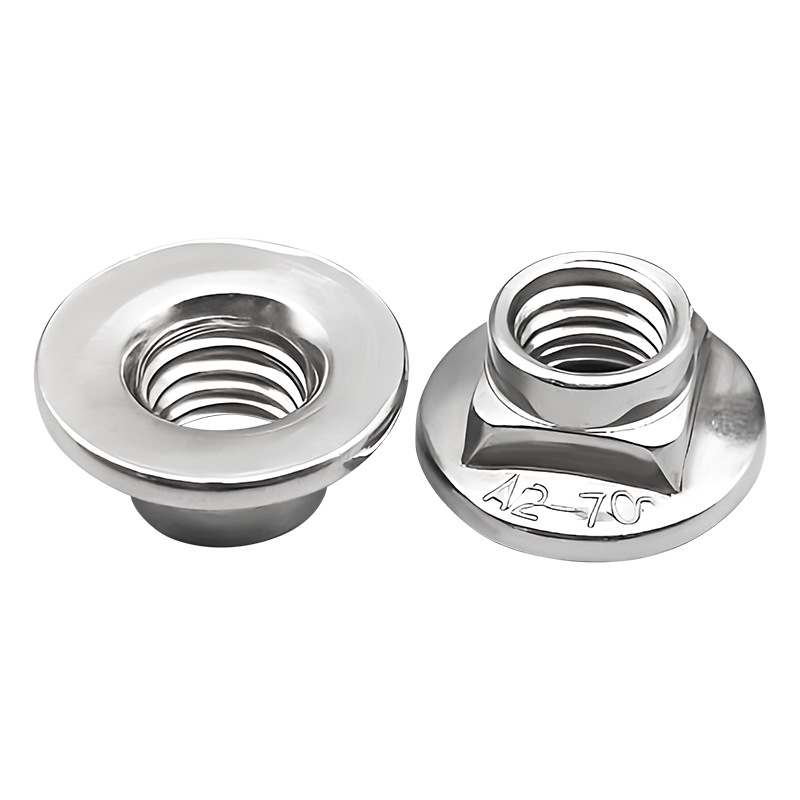
Using prevailing torque type lock nuts (e.g., EN ISO 7040 series).
-
High-strength preloaded bolt assemblies (HV series), which generate immense friction through precise preload to prevent loosening.
-
Pre-applied adhesive technology or the use of mechanical locking washers.
-
Dimensional Accuracy and Interchangeability:
To ensure efficient maintenance across vast rail transit networks, fasteners must possess extremely high dimensional accuracy and global interchangeability. Thread tolerances typically require Grade 6g/6H or higher precision.
-
Surface Treatment and Corrosion Resistance:
Fasteners must withstand erosion from rain, snow, cleaning agents, and de-icing salts. Dacromet (Geomet), hot-dip galvanizing (requiring dehydrogenation), and zinc-nickel alloy coatings are common choices, all requiring validation through thousands of hours of salt spray testing.
III. Certification and Quality Control Processes
-
Third-Party Certification: Products often require type approval or certification from authoritative railway bodies such as Germany's DB, France's NF, or the UK's RISAS.
-
First Article Inspection (FAI): Comprehensive inspection of dimensions, performance, and materials is conducted on the first batch of products, with data permanently archived.
-
Batch Traceability: Full-process information traceability is required, from the raw material heat number to the final finished product.
-
Production Process Audits: Clients or certification bodies conduct regular or irregular audits of the manufacturer's quality system, process control, and testing capabilities.
IV. Yongjing Precision's Practices and Commitments
Facing such high entry barriers, Yongjing Precision ensures its products meet the safety demands of rail transit through the following measures:
-
Deep Interpretation and Internalization of Standards: Dedicated positions are established to study standards like EN and TB/T, translating them into internal process control documents.
-
Investment in Dedicated Production Lines and Testing: A dedicated clean production line for rail transit products has been established, equipped with a full suite of testing equipment including spectrometers, metallographic microscopes, tensile testing machines, salt spray chambers, and transverse vibration testers.
-
Full-Process Traceability System: A QR code traceability system is implemented from steel warehousing to product outbound, ensuring complete and accessible data for every batch.
-
Collaborative Development with Clients: We actively participate in early-stage client design, providing connection solution optimization suggestions and cost analysis to jointly meet safety standards.
Conclusion
The safety standards for rail transit fasteners form a safety network woven from countless validations and rigorous clauses. They represent not just technical indicators, but a culture of supreme responsibility towards human life. Shenzhen Yongjing Precision Technology Co., Ltd. regards this as its own mission, manufacturing every fastener used in rail transit with a sense of reverence. With precision and reliability, we silently safeguard the safety and smoothness of every journey.


 135-6073-0094