
Products
Solutions
Applications
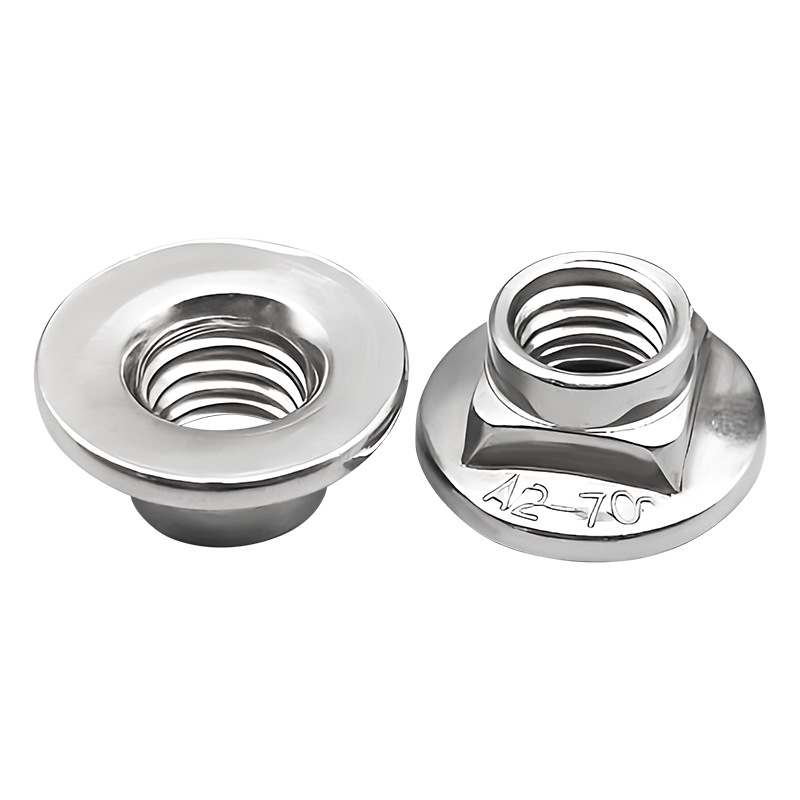
In the fastener field, nuts are core components used with bolts for fixing connections and load transfer. Self-locking nuts, combining both fastening and anti-loosening advantages, require no additional locking devices and adapt to complex working conditions. They are widely used in machinery, construction, new energy, and other sectors. Many only know they "prevent loosening" without understanding their working principles, type differences, or suitable applications.
Definition: A self-locking nut is a special nut that maintains connection tightness and prevents loosening under vibration, shock, and load changes using only its own structural design—no external locking parts like spring washers or cotter pins. Compared to ordinary nuts, the core advantage is self-locking anti-loosening, achieved by increasing thread friction or using mechanical clamping to counteract vibration-induced loosening.
Working Principle: Ordinary nuts loosen because the thread lead angle exceeds the friction angle. Under vibration or shock, friction decreases, allowing relative thread sliding and loosening. Self-locking nuts are designed so the lead angle is less than or equal to the friction angle, or mechanical clamping limits relative thread movement.
Two main principles:
Friction-based self-locking: Increases friction between threads or between nut and workpiece (e.g., nylon lock nuts, all-metal lock nuts).
Mechanical structure self-locking: Uses clamping or biting mechanisms to directly restrict relative rotation (e.g., slotted nuts, riveted nuts).
Common Types
1. Nylon Insert Lock Nuts – Most widely used. A nylon ring at one end has an inner diameter slightly smaller than the bolt outer diameter. When the bolt screws in, the nylon ring expands and tightly wraps around the bolt threads. High friction and elastic deformation create resistance, achieving self-locking.
Advantages: simple structure, low cost, easy installation, no extra devices, good insulation. Limitations: temperature range -40°C to 120°C (nylon softens/ages beyond this); nylon ring wears with repeated use. Suitable for non-frequent disassembly: home appliances, auto parts, PV mounting structures.
2. All-Metal Lock Nuts – Better high-temperature and wear resistance for harsh conditions with high heat, pressure, or vibration.
Elastic slot type: Threads have an elastic slot that deforms when the bolt is inserted, creating continuous clamping force.
Metal insert type: Embedded metal elastic piece or washer provides locking force through elastic deformation.
Suitable for high-temperature environments (engines, boilers, chemical equipment) – withstands over 200°C. Longer service life and more reuses than nylon lock nuts, but higher cost and require controlled tightening torque.
3. Slotted Nuts – Typical mechanical self-locking. 2-4 evenly distributed slots at one end, used with a cotter pin. After tightening, insert the cotter pin through a slot and the bolt hole, then bend the pin ends to restrict relative rotation.
Very reliable anti-loosening for extreme vibration and shock – used in aerospace, marine, heavy machinery. However, installation and removal are more tedious; cotter pins are single-use. Best for permanent, non-frequent disassembly of critical components.
Other Special Types: Riveted, self-clinching, and welded lock nuts – fixed to the workpiece for thin walls or sheets where traditional tightening isn't feasible (auto bodies, electronics enclosures).
Core Characteristics
Self-locking anti-loosening: No extra parts needed; maintains tightness under complex conditions.
Strong adaptability: Different types suit high/low temperature, vibration, insulation, etc.
Easy installation: Most can be tightened with standard wrenches.
Economical: Often lower cost than ordinary nut plus locking washer combinations, with fewer assembly steps.
Selection Guidelines
Consider three factors:
Working conditions: Temperature, vibration intensity, corrosive environment. High heat → all-metal lock nuts. Insulation needed → nylon insert lock nuts.
Disassembly frequency: Infrequent → nylon insert. Frequent → all-metal.
Load requirements: Heavy loads, strong shock → all-metal or slotted nuts. Light loads, mild vibration → nylon insert.
Usage Precautions
Apply moderate tightening torque – too high damages locking structure; too low cannot ensure locking force.
Do not exceed temperature or corrosion limits (e.g., no nylon lock nuts in high heat).
After repeated disassembly, check locking structure for wear. Replace if nylon ring or metal spring shows damage or deformation.
Ensure thread compatibility between bolt and nut.
For fastener companies, self-locking nuts are high-value specialty products. R&D and production capability directly reflect technical strength. As downstream industries (new energy, aerospace, high-end equipment) upgrade, requirements increase – not only reliable anti-loosening but also lightweighting, high precision, and corrosion resistance. Companies should increase R&D investment, optimize product design, improve quality, and educate customers on proper selection and use.
Self-locking nuts may look like upgraded ordinary nuts, but behind them are scientific structural designs and working principles. They are key components ensuring secure connections and safe operation of equipment. Understanding types, principles, characteristics, and applications helps with accurate selection, proper use, and meeting fastening needs under different conditions. As industrial technology advances, self-locking nuts will see wider applications, with continuous improvements in structure and performance – injecting new momentum into high-quality development of the fastener industry.
Professional consultant team online, ready to provide solutions for you
Contact NowProducts
Solutions
Applications
Contact
Contact
WeChat
Contact: Manager Fan - Tel/WeChat: 135-6073-0094 Email: Flora.Fan@toprecision.com | Manager Ao - Tel/WeChat: 13560729614 Email: Olia.Ao@toprecision.com
Sales Director: Mr. Zhang - Tel: 13510369429 Email: xiaowei.zhang@zcjtech.com
© Copyright 2011 - 2026 Shenzhen Toprecision Precision Technology Co., Ltd. All Rights Reserved.
粤ICP备2025493240号-1
Cutter Screws
Thread Inserts
Sealing Products
Riveting Products
Locking Products
Direct Assembly
SMT Components
Precision Screws
Screwdriver Bits